Regular vs. Direct Mutual Funds: The Hidden Commissions Costing You Lakhs

Regular vs. Direct Mutual Funds: The Hidden Commissions Costing You Lakhs

The wealth management industry has spent decades quietly building a highly lucrative architecture designed to profit from your passivity. For generations, the standard procedure for buying a mutual fund was straightforward: you walked into a bank, met with a relationship manager, or spoke with a local financial distributor. They smiled, handed you a stack of paperwork, and selected a portfolio of funds for you. You felt a deep sense of relief, assuming that someone else was managing your financial future. What they rarely mentioned—and what was buried deep within the fine print of the mandatory statutory disclosures—was that a fraction of your wealth was being systematically diverted every single year to fund their commission payouts.

The financial grid is masterfully engineered to feel intimidating, forcing rational, high-earning individuals to rely on intermediaries out of sheer intimidation. But a silent revolution occurred when regulatory frameworks introduced an alternative gateway. Suddenly, you were granted direct access to the exact same investment engines, completely free of middleman commissions. If you are currently trying to navigate the regular vs direct fund matrix, you are standing at a major crossroad that will entirely dictate your net worth over the next twenty years. This exhaustive guide will break down the mechanics of the wealth management pipeline, expose the hidden mathematics of compound friction, and show you exactly how much capital you can reclaim by eliminating unnecessary distributors.

The Quick Answer

The Core Variance: The fundamental regular vs direct fund distinction lies entirely within the pricing structure; regular plans include an embedded trailing commission paid out continuously to a distributor, while direct plans bypass intermediaries completely.
The Mathematical Impact: Direct funds feature a significantly lower annual expense ratio. While a 1% difference looks trivial on a single monthly ledger statement, this delta compounds over a rolling twenty-year horizon, saving long-term investors lakhs of rupees in unearned intermediary fees.
The Operational Blueprint: If you possess the basic digital literacy to select your own portfolios or rely on low-cost fee-only investment advisory systems, migrating your equity holdings from a regular plan to a direct option is a crucial portfolio move.

1. Dismantling the Blueprint: The Trailing Commission Trap

To truly understand how the choice of a regular vs direct fund fundamentally rewrites your portfolio’s compounding performance, you must first demystify how mutual fund assets are structurally valued. When you buy a mutual fund, you aren’t just paying for the underlying basket of stocks or bonds. You are paying an ongoing administrative operational fee known as the Expense Ratio.

The expense ratio is an annual percentage fee deducted continuously from the fund’s total assets under management (AUM) to pay for the fund manager’s salary, compliance teams, marketing infrastructure, and institutional research tools. This deduction is reflected inside the daily Net Asset Value (NAV) of your portfolio. If a fund manages a net asset base and carries an expense ratio of 2%, that fee is peeled away incrementally every single trading day.

Mutual fund annual operational expense diagram comparing regular vs direct plan fees, highlighting distributor commissions in regular plans and lower costs in direct plans.

When you select a regular mutual fund plan, your broker or advisor isn’t charging you an upfront fee out of your pocket. Instead, the mutual fund house embeds a trailing commission directly into the regular plan’s daily expense ratio. This trailing commission usually ranges from 0.5% to 1.5% per annum.

The fund house collects this money automatically and forwards it to your distributor every single month for as long as your money remains inside the fund. The distributor receives a steady stream of passive income pulled directly from your wealth ledger. Whether the market is experiencing a massive bull run or a brutal, blood-red crash, the distributor’s trailing commission gets paid without exception. It is a continuous extraction of capital that operates silently in the background of your app interface.

2. The Direct Alternative: Entering the Commission-Free Zone

In January 2013, the Securities and Exchange Board of India (SEBI) executed a landmark regulatory masterstroke that permanently altered the retail wealth management ecosystem. They mandated that every mutual fund house in India must launch a separate, clean gateway for every single product in their catalog. This gateway was designated as the Direct Plan.

A direct fund is the exact same product as its regular counterpart. It is managed by the exact same fund manager, holds the exact same basket of large-cap or mid-cap equities, uses the identical institutional research framework, and carries the same structural risks. If the regular plan of a growth fund purchases a block of blue-chip stock, the direct plan buys the exact same asset at the exact same microsecond.

The single structural variance is the total omission of the distributor link. Because there is no middleman to pay, no bank relationship manager to reward, and no legacy broker network to subsidize, the fund house strips the trailing commission completely out of the asset’s pricing engine.

The daily expense ratio of a direct plan drops precipitously. This lower operational fee causes the daily NAV of the direct plan to tick higher than the regular version every single day. If you want to monitor these precise daily pricing variances across the entire mutual fund universe, you can track the official statistical data logs archived on the Association of Best Demat Account India Mutual Funds in India (AMFI) database.

3. The Compounding Math: How 1% Steals Lakhs Over 20 Years

When a retail investor sits down to compare a regular vs direct fund, their brain frequently plays a dangerous cognitive trick. They open two sheets, see that the regular plan carries an expense ratio of 1.8%, while the direct plan sits at 0.8%, and assume a 1% variance is entirely trivial. They view it as a minimal fee to pay for convenience.

This assumption is a catastrophic mathematical failure. You are forgetting that mutual fund expenses do not function like a flat subscription service. They are percentage deductions levied against your aggregate, compounding asset base over time.

Let’s look past theoretical generalizations and analyze an uncompromised mathematical simulation. Imagine a salaried professional who establishes a Systematic Investment Plan (SIP) of ₹25,000 every month into an aggressive equity fund. They commit to maintaining this discipline over a rolling twenty-year horizon. We will assume the underlying corporate equity execution delivers a standard, realistic compounded annualized growth rate (CAGR) of 12% before operational expenses.

The Regular Plan Calculation (Expense\ Ratio = 1.8\%)

Because the trailing commission is continuously bleeding the daily asset valuation, the net investment return realized by the investor drops from 12% down to 10.2% after costs. Over a twenty-year span, the total principal capital injected by the professional equals exactly ₹60,000,000. Under the law of monthly compounding, the final net valuation of this portfolio settles at approximately ₹1,85,60,000.

The Direct Plan Calculation (Expense\ Ratio = 0.8\%)

Because the distributor has been entirely bypassed, the net investment return realized by the direct investor climbs to 11.2% after operational expenses. The professional inputs the exact same ₹25,000 monthly cadence, accumulating identical principal over twenty years. However, under this cleaner pricing tier, the final net valuation of the portfolio scales to approximately ₹2,11,40,000.

The Searing Cost of Ignorance

When you calculate the absolute delta between these two final balance parameters, the results are deeply sobering:

$$\Delta = ₹2,11,40,000 – ₹1,85,60,000 = ₹25,80,000$$

You lost over ₹25.8 Lakhs of pure, unadulterated wealth. That money did not evaporate during a market crash, nor was it swallowed by corporate tax changes. It was systematically extracted from your secure digital vault to pay for your distributor’s passive business overhead.

You bore 100% of the financial risk, navigated multiple brutal market corrections, maintained incredible savings discipline for two decades, and handed over a massive chunk of your final financial freedom to an intermediary who simply forwarded a link. If you are serious about long-term survival, tracking these wealth traps is precisely why mastering an advanced financial risk management blueprint is an absolute career necessity.

4. The Advanced Technical Framework: Charting the NAV Divergence

To accurately visualize how this minor percentage variance compounds into an unshakeable wealth chasm, look at how the daily Net Asset Value (NAV) updates on an advanced charting dashboard. If you load an overlay chart tracking the regular vs. direct version of the exact same large-cap fund across a ten-year timeline, you will see a phenomenon known as geometric divergence.

On day one, both charts start at an identical baseline. But by day two, the direct plan’s NAV climbs fractionally higher because its internal expense friction is lower. By year five, this fraction has transformed into a massive structural price gap.

As the broader equity trend climbs, the direct chart pulls away exponentially. This is because the money saved on commissions remains inside your vault, acting as a secondary compounding engine. The saved fees purchase more units of the underlying companies, which then generate more internal growth, creating a powerful loop.

fund direct vs regular plan growth chart showing higher NAV compounding in direct plans and the long-term impact of lower expense ratios.

Traders and quantitative specialists track these visual charts meticulously to optimize their portfolio entries. If you want to develop a highly disciplined, visual framework to read structural trend directions, identify major institutional support zones on daily candlesticks, and understand when to time your entries cleanly, studying a complete beginner’s guide to technical analysis in India offers an unmatched technical edge. Applying these precise visual chart models to your mutual fund asset tracking completely removes emotional guesswork from your long-term wealth calculations.

5. Identifying the Operational Gateway: Discount vs. Bank Intermediaries

If the mathematical reality of direct funds is so overwhelmingly superior, why do regular plans continue to hold billions of rupees of retail assets? They survive because traditional banking institutions and legacy full-service brokers deploy powerful cognitive framing techniques to preserve their lucrative commission fees.

The Illusory Comfort of the Full-Service Pitch

Traditional banks approach retail clients with an alluring pitch: “We offer complete financial convenience. We integrate your savings account directly into our wealth platform, provide access to an elite relationship manager, and send you curated lists of recommended mutual funds every month, all for zero upfront fee.”

This convenience is a marketing illusion. The relationship manager is not an independent fiduciary advisor. They are corporate salespeople working under intense monthly transaction quotas.

They are heavily incentivized to route your family’s life savings into the specific regular plans that carry the absolute highest internal trailing commission tiers, even if those funds underperform the baseline index. They frame the service as a complimentary benefit, completely hiding the reality that you are paying them lakhs of rupees via compound friction over twenty years.

Modern Discount Brokers: Bypassing the Noise

To break away from this opaque ecosystem, tech-savvy value investors route their wealth through modern digital discount brokerage networks. Platforms like Zerodha (Coin) and Groww have engineered clean, friction-free interfaces built specifically to support direct fund execution.

When you purchase a mutual fund through a modern discount gateway, there are no relationship managers calling you to pitch ideas, no hidden trailing commissions, and no continuous wealth extractions. The platform functions as a clean, automated digital conduit to the central exchanges, ensuring that every single paisa of your savings is funneled directly into building your actual equity portfolio base.

6. The Psychological Trap: Intentional Advisory vs. Biased Tips

Transitioning your assets into direct funds requires an honest assessment of your own psychological wiring and behavioral discipline. You must be brutally honest about your own market bandwidth.

The Hazard of the Fragmented DIY Path

The primary argument deployed by defenders of the regular mutual fund model is simple: “Beginners lack the technical competence to select their own mutual funds. If they go direct, they will panic during a market correction, overtrade, buy high, sell low, and destroy their portfolios out of pure emotional confusion.”

This hazard is entirely real. Downloading an application onto your smartphone does not magically grant you financial competence any more than purchasing an elite scalpel makes you a skilled surgeon.

Many self-taught retail investors switch to direct funds to save a few bucks on fees, but then spend their weekends consuming fragmented, ad-hoc advice on social media video channels. They chase speculative sector trends, overcomplicate their watchlists with ten competing products, and freeze when a major market correction tests their discipline. If you treat direct investing as a casual game of chasing short-term performance tables, you can easily lose far more money through poor execution than you reclaim by cutting out commissions.

The Fee-Only Advisory Sanctuary

If you do not possess the lifestyle bandwidth to independently monitor macro markets, run portfolio rebalancing metrics, and track underlying sector exposures, the correct alternative is not to retreat into the regular commission model. The professional solution is to partner with a Registered Investment Advisor (RIA) who operates on a Fee-Only pricing structure.

A fee-only advisor does not accept trailing commissions from mutual fund houses. They refuse to touch regular plans. They charge you a flat, transparent upfront fee (e.g., ₹15,000 per year) to design a bespoke financial roadmap, review your asset allocation, and hold your hand through market drawdowns.

Because their compensation is entirely detached from the products they recommend, their fiduciary alignment is absolute. They help you execute a clean portfolio composed exclusively of direct funds, ensuring that your wealth architecture remains completely immune to institutional sales bias.

7. The Testing Ground: Validating Execution via Sandboxes

Before you execute a massive structural overhaul of your family’s investment infrastructure, migrating allocations worth lakhs from a traditional banking platform onto a modern discount interface, you must master the physical mechanics of online order entry. Making a hasty, careless mistake on a digital dashboard can trigger immediate, unmanaged tax liabilities or accidental exit load penalties.

Treat your platform transition precisely like a professional trading operation. Before moving real capital under live conditions, complete a rigorous validation phase inside a zero-risk sandbox.

Practice the precise, line-by-line administrative steps:

Map Your Electronic KYC Credentials: Ensure your legal identity parameters are perfectly synchronized across all depository systems.
Audit the Automated Mandate Tooling: Practice configuring a Systematic Investment Plan (SIP) mandate to verify that your bank’s electronic transfer limits are perfectly calibrated.
Journal Your Portfolio Constraints: Meticulously document your fundamental reasoning for selecting a specific asset allocation tier, mapping your long-term capital horizons safely away from your short-term spending cash.

Spending a multi-week period testing your execution routines inside simulated paper workspaces removes mechanical friction and protects you from costly real-money errors. For individuals looking for a highly structured, week-by-week blueprint to navigate this critical developmental transition cleanly without chaos, working through a complete, mentor-led 8-week stock trading plan offers an indispensable operational gateway to master the modern financial grid.

8. Defeating the Behavioral Spiral: Capital Preservation Rules

The stock market is an unforgiving financial machine engineered to systematically extract wealth from the chaotic speculator and hand it directly to the highly rule-based operator. While regular mutual fund platforms encourage a culture of passive comfort, managing a direct portfolio requires absolute adherence to capital preservation guardrails.

Novice investors almost always lose money because they panic during routine market drawdowns. When the macroeconomic cycle contracts, the global data lines trigger a correction, and your portfolio valuation drops by 15% in a single month, emotional anxiety can easily freeze your execution. You skip your monthly SIP input, attempt to time the absolute bottom of the cycle based on news speculation, or panic-sell your finest compounding assets near the lowest point of the correction.

The 2% Portfolio Risk Firewall

Surviving these emotional drawdowns demands that you implement rigid, mechanical boundaries before your money is ever put at risk. Even when managing a portfolio of mutual funds, you must maintain intense risk containment.

Never allow an individual speculative sector asset or highly concentrated thematic fund to command more than 10% to 15% of your total wealth vault. Keep your core capital anchored in highly diversified, low-cost index products or broad large-cap equity vehicles.

By bounding your localized exposure, a severe cyclical downturn in one specific industrial sector remains a manageable setback rather than an account-destroying event. To learn exactly how these mathematical risk models operate under live market conditions to shield your lifetime savings from preventable destruction, integrating a disciplined protocol for managing risk in the Indian stock market is an absolute necessity.

9. Shifting From Online Chaos to Immersive Mentorship

The structural barriers to entering the Indian wealth ecosystem have been entirely flattened by consumer technology. The fact that any independent investor can track their portfolio value or allocate capital on a smartphone while waiting for a bus is a true technological miracle. However, this effortless accessibility creates a profound behavioral illusion. Newcomers assume that because they have access to elite software tools and thousands of free online articles, they automatically possess financial competence.

They spend months consuming fragmented, ad-hoc information streams, patching together random financial theories they barely understand, and wondering why their long-term portfolios constantly underperform the simple market indices. Free online content can give you raw definitions; it cannot provide personal accountability, real-time portfolio correction, or the psychological guidance needed to hold an asset under severe macroeconomic pressure. It takes a solo beginner years of painful emotional cycles to recognize the specific behavioral blind spots that an expert mentor can identify in ten minutes.

The difference between achieving market consistency in a few months versus spending years churning your capital often comes down to the quality of the feedback loop you build during your development. Having active market practitioners review your execution logs, critique your asset allocation, and correct your strategic reasoning in real time saves you months of preventable drawdowns.

For aspiring systematic operators across the Delhi-National Capital Region (NCR) who wish to escape the trial-and-error cycle of solo investing, transitioning into a physical, mentor-led environment is a profound structural upgrade. This is precisely why specialized hubs like the Trading Smart Edge (TSE) Institute in Pitampura, Delhi operate.

Rather than leaving independent investors to navigate dangerous traps alone, a professional training curriculum pairs beginners with active market practitioners inside live-market training rooms. Students learn to design robust asset allocation frameworks, handle advanced portfolio tools, prepare for NISM certifications, and receive immediate corrective feedback on strategic errors before their capital is damaged.

Learning how to properly evaluate an educational institute is a critical skill for any serious participant. If you want a clear checklist to assess coaching quality across the region, reading our comprehensive strategic guide on choosing a reliable trading academy in Delhi NCR breaks down the exact credentials and criteria to verify before enrolling your time and resources. Furthermore, if you eventually choose to allocate a portion of your capital toward high-velocity trading strategies, studying our dedicated masterclass on building consistent intraday trading profits in India provides the ultimate operational standard to strive toward.

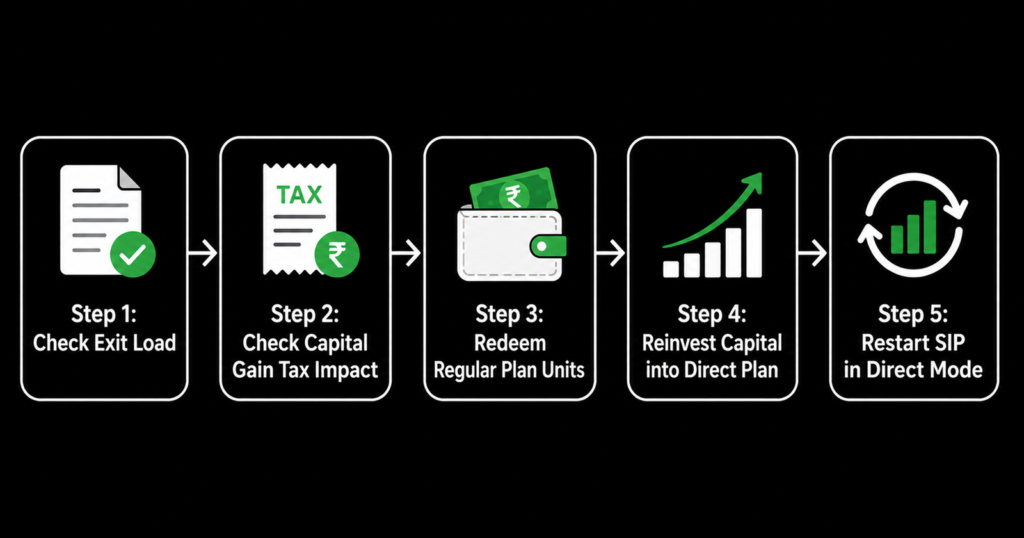
10. Your Migration Roadmap: Moving From Regular to Direct

If you currently hold an active portfolio of mutual funds through a legacy bank or a traditional broker, how do you physically execute the transition to a direct plan? You cannot simply click a toggle switch inside your old app; you must execute a formal, methodical migration process.

Step 1: Execute a Complete Portfolio Audit

Log into your current investment portal and download your comprehensive Capital Gains Statement and your Consolidated Account Statement (CAS) from the central depository platform. Identify exactly which funds are designated as “Regular” and note their current accumulated units and underlying purchase dates.

Step 2: Calculate the Exit Load Boundaries

Mutual fund houses protect their asset bases by charging an exit penalty if you liquidate your units within a specific timeframe after purchase—typically 1% if you exit within 365 days of allocation. Check the fine print of your specific funds. To avoid paying unearned penalties, map your migration to target only those units that have comfortably cleared their exit load windows.

Step 3: Audit the Tax Implications

This is the absolute critical path of your migration. The government treats the act of moving from a regular plan to a direct plan precisely as a redemption event. You are technically selling the regular asset and purchasing a brand-new asset inside the direct framework.

This means the transaction triggers capital gains taxes:

Short-Term Capital Gains (STCG): Levied at a premium rate if you redeem your equity units within 365 days of purchase.
Long-Term Capital Gains (LTCG): Applied to units held for over a year, though the tax code historically features generous annual tax-exempt profit thresholds for long-term equity gains.

Consult your tax consultant or use advanced tax ledger calculators to ensure your transition executes inside your optimal annual tax allowances without triggering unexpected fiscal liabilities.

Step 4: Stop the Old Automated Mandates

Log into your legacy banking interface and permanently cancel all active SIP automated mandates pointing toward regular plans. This immediately plugs the financial leak, ensuring that no new capital is funneled into high-expense commission structures while you organize your transition.

Step 5: Initialize the New Direct Pipelines

Open your new, clean discount brokerage terminal or independent platform. Establish identical monthly SIP allocations pointing directly toward the Direct-Growth plans of your chosen funds.

Once your legacy regular units clear their tax and exit load boundaries, systematically redeem them from the old interface and transfer the settled cash directly into your clean direct gateway. This simple, disciplined process safely locks your wealth compounding engine into the most efficient pricing tier available in capitalism.

Your Pre-Launch Operational Verification Checklist

Before you authenticate your primary bank link and place your very first direct fund transaction tomorrow morning, pass your workspace through this final operational verification checklist to guarantee your system is completely optimized:

Link an Uncompromised Mobile Gateway: Verify that your Aadhaar card, PAN, broker portal, and bank account are synchronized to a singular, active phone number utilizing robust two-factor authentication (2FA).
Confirm Your Nominal Beneficiary: Ensure you explicitly assign a legal nominee during the Demat account configuration phase. This protects your family from agonizing bureaucratic hurdles if your wealth assets ever need to be securely transferred to your heirs.
Audit the Tax Ledger Tooling: Verify that your chosen broking platform features an advanced, clean capital gains reporting engine. Come tax season, you will need an interface that breaks down short-term capital gains, long-term holdings, and business turnovers smoothly without calculation bugs.
Verify the Electronic Delivery (e-DIS) Mandate: Establish your central TPIN framework immediately upon account activation. This allows your terminal to digitally authorize delivery and sell transactions securely without processing stalls, completely eliminating legacy paper processing while securing your assets from unauthorized movement.

The modern Indian retail ecosystem is navigating an unprecedented structural golden age. The capital market efficiency, fundamental data transparency, and low transactional barriers accessible on your smartphone terminal today were completely unavailable to elite institutional fund desks twenty years ago. The tools of exponential wealth creation have been entirely democratized. Choose the platform that aligns flawlessly with your current lifestyle and cognitive wiring, protect your lowercase assets with unyielding risk boundaries, and select the optimal direct fund configurations to let your wealth compound systematically. The gateway is completely optimized; executed with absolute care

Share this :

Leave a Comment

Your email address will not be published. Required fields are marked *

Scroll to Top