Open up your preferred brokerage application right now. Look closely at the dashboard. You will see two completely different financial universes colliding on a single digital screen. On one side, conservative investors are quietly accumulating shares, tracking quarterly earnings, and collecting modest dividends. On the other side, aggressive speculators are executing highly leveraged derivative contracts, wrestling with volatile weekly expirations, and chasing massive intraday returns. If you are standing at this financial crossroads with your hard-earned capital, you are facing the ultimate dilemma. You are trying to definitively settle the fierce debate of f&o trading vs cash market.
Choosing between f&o trading vs cash market is not merely a matter of personal preference or aesthetic style. It is a fundamental decision that dictates your mathematical probability of survival in the financial ecosystem. Choose correctly, and you can build a methodical, compounding wealth machine. Choose poorly, and you risk joining the grim statistics of retail traders who entirely obliterate their net worth before they even understand what hit them.
The internet is flooded with screenshots of massive derivative profits and influencers selling the dream of overnight wealth. But what is the actual truth? When we objectively analyze f&o trading vs cash market, which arena actually serves the retail participant? Let us strip away the complex financial jargon, look at the cold regulatory data, and figure out exactly which path aligns with your financial goals.
Quick Answer
What is the core difference in f&o trading vs cash market?
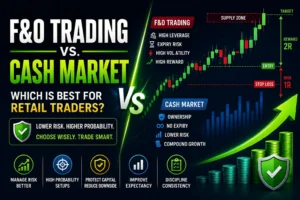
- Cash Market (Equity): Involves buying actual shares of a company. You own a fractional piece of a real business. It carries significantly lower risk, has absolutely zero expiration dates, and uses no leverage. Time is your greatest ally.
- F&O Market (Derivatives): Involves buying or selling contracts based on the future price of an asset. It utilizes massive leverage, amplifying both your profits and your losses. Every contract has a strict expiration date; if your prediction is wrong by that specific date, your investment can expire completely worthless. For 95% of retail traders, the cash market is the only sustainable choice.
Table of Contents
Decoding the Foundations: What Are We Actually Trading?
Before we can dig into the granular risk metrics of f&o trading vs cash market, we need to establish the philosophical difference between these two arenas. You cannot trade effectively if you do not deeply understand the structural reality of the asset sitting in your demat account.
The Cash Market: The Fortress of True Ownership
When you execute a buy order for a stock in the cash equity segment, you are executing a transaction of actual, legal ownership. You are buying a tiny, fractional piece of a living, breathing corporation. You officially own a microscopic percentage of their factories, their proprietary patents, their cash reserves, and their future cash flows.
Because you are a legitimate part-owner, the cash market offers you an incredible luxury: infinite time.
You can hold that digital piece of paper in your demat account forever. If you buy shares of a fundamentally phenomenal company on a Tuesday, and the stock price suddenly drops 8% on Wednesday because of an unexpected global macroeconomic panic, you have not actually lost any money. You only realize that loss if you panic and click the sell button. You have the absolute luxury of waiting three weeks, three months, or three years for the broader market to recover and for the company’s inherent value to be recognized again.
While you patiently wait out the storm, the business continues to sell products. It continues to generate revenue. It continues to pay out quarterly dividends directly into your bank account. The market can be completely irrational about the stock’s price for extended periods, but as long as the underlying business is generating cash, your capital is structurally safe. When evaluating f&o trading vs cash market, this inherent safety net makes the cash market incredibly forgiving for developing retail traders.
The F&O Segment: The Derivative Reality
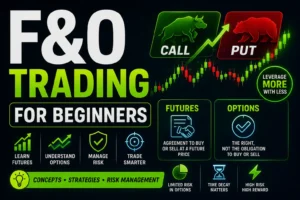
Options and Futures are entirely different animals. They are financial derivatives. They derive their numerical value purely from the price movements of the underlying stock or market index. To understand the core of f&o trading vs cash market, you must internalize one absolute fact: when you buy an option, you do not own the company. You own a temporary, highly volatile paper contract.
For a deeply authoritative explanation of how these instruments are structured globally, reviewing Investopedia’s comprehensive breakdown of derivatives provides essential context.
And that specific derivative contract comes with a ticking time bomb permanently attached to it. That time bomb is the expiration date.
In the Indian financial markets, equity and index options typically expire on the last Thursday of the month, while massive, high-volume indices like the Bank Nifty and FinNifty feature extremely aggressive weekly expiries. This is the crux of the derivative environment. Time is no longer your ally; it is a hostile, aggressive weapon working actively against you.
If your specific prediction about the stock’s directional movement does not happen before that exact expiration date strikes, your derivative contract expires completely worthless. You lose 100% of the premium you paid. The underlying stock could make the exact 10% upward move you predicted just two days after your option expires, but it will not matter. You are already wiped out. The f&o trading vs cash market comparison highlights that derivatives demand not just precise directional accuracy, but surgical timing accuracy.
The Mechanics: Leverage, Margin, and Time
For anyone serious about protecting their capital and building a sustainable trading business, intimately understanding the mechanical differences of f&o trading vs cash market is the absolute first step toward survival. Let us break down the exact mathematical and regulatory forces at play.
The Leverage Factor (A Double-Edged Sword)
You cannot have an honest discussion about f&o trading vs cash market without confronting the terrifying reality of leverage. Leverage is the absolute superpower of the derivatives market, and it is the exact mechanism that aggressively bankrupts inexperienced retail traders every single week.
In the cash market, if you want to buy 1,000 shares of a stock priced at ₹1,000, you must have exactly ₹10,00,000 (10 Lakhs) sitting freely in your demat account. It is a strict 1:1 transaction. There is no debt. There is no margin.
In the options and futures market, trades are executed in standardized, exchange-mandated batches called “Lots.” You can view these exact contract specifications directly on the National Stock Exchange (NSE) equity derivatives platform. Buying one lot of a futures or options contract allows you to control massive amounts of underlying stock for a tiny fraction of the total cost. You might only pay a premium of ₹15,000 to control a position with a notional value of ₹10 Lakhs.
This leverage amplifies your wins spectacularly. A tiny 2% move in the stock can result in a 50% return on your deployed capital. But it amplifies your losses with equal, merciless brutality. If the stock gaps down heavily against you, your entire margin can be annihilated in seconds.
Margin Requirements & SEBI’s 2026 Regulatory Crackdown
Understanding f&o trading vs cash market requires acknowledging the massive regulatory shifts that occurred recently. In response to catastrophic retail losses, the Securities and Exchange Board of India (SEBI) heavily tightened the derivative framework from late 2024 through 2026.
The most impactful change to the landscape of f&o trading vs cash market was the strict 50:50 Margin Rule. To curb reckless retail leverage, SEBI mandated that at least 50% of the total margin required for any open F&O position must be held in pure cash or highly liquid cash equivalents (like overnight funds). Previously, traders could use pledged stocks or equity mutual funds as 100% of their margin. By forcing traders to lock up hard cash, SEBI structurally restricted the amount of leverage retail participants could irresponsibly deploy. This makes the barrier to entry for professional option selling significantly higher than it was a few years ago.
Risk and Reward Asymmetry in F&O Trading vs Cash Market
In the traditional cash equity market, risk and reward are beautifully linear. It is simple arithmetic. If you buy ₹1,00,000 worth of HDFC Bank stock and the price goes up by 5%, you make exactly ₹5,000. If the price goes down by 5%, your portfolio shows a temporary, unrealized loss of exactly ₹5,000. Your downside is strictly limited to the actual cash you deployed, and a total wipeout is virtually impossible unless the company goes entirely bankrupt overnight.
When we evaluate f&o trading vs cash market, we see that options operate in a world of complex, non-linear asymmetry. The risk profile shifts violently depending on whether you are buying or selling the contracts.
Option Buyers vs. Option Sellers
- Option Buyers: If you buy a Call or Put option, your maximum risk is strictly limited to the premium you paid. If you buy an option for ₹5,000, you can never lose more than ₹5,000. However, your upside is theoretically infinite. If the market makes a massive, unexpected move in your direction, that ₹5,000 premium can explode to ₹25,000 in a matter of hours. This mathematically skewed reward profile is precisely what lures millions of retail traders into the segment.
- Option Sellers (Writers): Option sellers act like insurance companies. They collect the premium upfront from the buyers. Because roughly 70% to 80% of all out-of-the-money (OTM) options expire completely worthless, the seller simply keeps the premium as pure profit. However, their risk is theoretically unlimited. If the market crashes violently against an option seller, they are legally on the hook to cover the massive difference. A seller could collect a tiny ₹2,000 premium and end up losing ₹80,000 in a single afternoon if a “black swan” market event occurs.
The Hidden Math: The Greeks
If you want to trade cash equity, your primary job is simple: accurately determine if the stock price is going to go up or down.
If you want to trade options, directional bias is merely the very first step. Option premiums do not move randomly. They are governed by a complex set of mathematical variables collectively known as “The Greeks.”
- Delta (The Speed Limit): Measures exactly how much the option’s premium will change for every ₹1 change in the underlying stock.
- Theta (The Silent Killer): Options are wasting assets. Theta measures how much value your option loses every single day simply because time is passing. If you buy an option and the stock price stays perfectly flat for a week, you will lose a significant amount of money purely to Theta decay.
- Vega (The Panic Button): Measures sensitivity to Implied Volatility (IV). When the broader market panics, volatility spikes violently. When volatility spikes, option premiums become incredibly expensive, completely independent of the stock’s actual direction.
You do not need to know what a Delta or a Theta is to buy Reliance shares and hold them for five years. But if you ignore these mathematical realities in the options market, you will be systematically drained of your capital. This is why f&o trading vs cash market is not a fair fight for the uneducated trader.
The Brutal Reality: SEBI’s F&O Loss Statistics
Any honest, objective guide explaining the realities of f&o trading vs cash market must forcefully address the absolute bloodbath happening in retail derivative accounts across the country. We cannot rely on opinions; we must look at the hard data.
Recent exhaustive studies released by SEBI analyzing trading patterns between FY22 and FY24 revealed a truly devastating statistic: 93% of individual retail traders in the equity F&O segment incurred net losses. The aggregate, collective losses of these individual traders exceeded a staggering ₹1.8 Lakh Crores over a three-year period.
Even more terrifying? The top 3.5% of loss-makers faced an average, soul-crushing loss of ₹28 Lakhs per person. Furthermore, retail traders collectively burned through roughly ₹50,000 Crores just paying transaction costs, brokerage fees, and exchange levies. Only a meager 1% of individual traders managed to earn sustainable profits exceeding ₹1 Lakh after adjusting for massive transaction costs.
Who was actually making the money? The SEBI data was clear: foreign portfolio investors (FPIs) and proprietary algorithmic trading desks. These entities booked tens of thousands of crores in gross profits. They are harvesting the premiums that retail traders gladly hand over week after week.
The 2026 STT Taxation Shock
Beyond income tax, the transactional costs of options trading have skyrocketed. To further discourage the speculative frenzy seen in f&o trading vs cash market, the Finance Ministry aggressively hiked the Securities Transaction Tax (STT) on derivatives in the 2026 Union Budget.
The STT on options premiums increased by 50% to 0.15%, and futures STT jumped 150% to 0.05% (effective April 2026). This means every single time you execute a highly leveraged trade, a significantly larger chunk of your potential profit is instantly taken by the government and the exchange, regardless of whether your trade ultimately wins or loses. For a clear understanding of how these taxes apply to your overall return filing, ClearTax’s comprehensive F&O tax guide is an invaluable resource.
When you factor in these massive frictional costs, the f&o trading vs cash market debate heavily favors the cash market for anyone lacking institutional-grade algorithms.
Choosing Your Path: Who Should Trade What?
You do not have to violently choose one side of the f&o trading vs cash market debate immediately. Professional, highly experienced retail traders usually start in one arena and slowly graduate to the next as their capital and competence fundamentally grow.
Why Beginners Must Start with Cash Equity
If you have less than ₹5 Lakhs in active trading capital and are still struggling to read basic market structure, stay far, far away from the derivatives segment. The cash equity market is your rightful home.
Focus obsessively on mastering the art of swing trading. Learn to capture consistent 4% to 6% directional moves in high-liquidity Nifty 50 and Nifty Next 50 stocks over two-week holding periods. It is the absolute safest, most mathematically reliable way for a beginner to build early cash flow without the constant, terrifying threat of total account ruin.
To execute this effectively, you must learn to read the psychological footprint of the market. Understanding how to read candlestick charts allows you to see exactly where institutional buyers are stepping in to defend price levels. Establishing this foundation through a premier educational platform ensures you are trading with logic, not raw emotion. If you want to accelerate this learning curve, exploring how to do technical analysis for stock trading is the perfect transition from gambling to systematic investing.
When to Graduate to Derivatives
If you possess a highly liquid capital base exceeding ₹15 Lakhs, have survived the brutal swings of the cash markets for at least three full years, and intimately understand the intricacies of Greek math, implied volatility, and delta hedging, then conservative option selling can become an incredibly powerful regular income generator.
Becoming the insurance company allows you to harvest Theta decay methodically, profiting quietly even when the market refuses to trend. But this graduation requires immense discipline. You must be willing to accept that f&o trading vs cash market is a completely different psychological battlefield. If you are struggling with risk management, partnering with a stock market institute in Delhi or a dedicated mentor can provide the accountability necessary to survive the derivative space.
Structuring a Hybrid Approach (Covered Calls)
You do not necessarily have to view the f&o trading vs cash market debate as a binary choice. Professional retail traders often blend the unparalleled safety of the cash market with the yield-generation power of the derivatives market using a brilliant, conservative strategy known as the Covered Call.
This hybrid strategy bridges the wide gap in f&o trading vs cash market perfectly.
Imagine you hold a large, long-term portfolio of a highly liquid stock like Reliance Industries. Let’s say you own 250 shares, currently trading at ₹3,000 per share. That is ₹7.5 Lakhs of your core capital tied up. Reliance is consolidating; it isn’t moving much, and it pays a relatively meager dividend. You want to heavily juice your regular income returns on this idle capital without taking on insane, directional derivative risk.
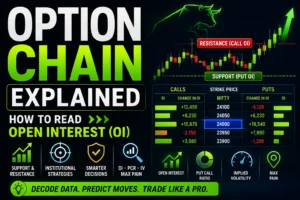
So, you pull up the options chain. You notice that the ₹3,200 Call option expiring at the end of the current month is currently trading for a premium of ₹30. Since the standard, exchange-mandated lot size of Reliance F&O contracts is exactly 250 shares, you decide to sell one lot of the ₹3,200 Call option.
You instantly collect ₹7,500 in cash premium directly into your trading account.
- If Reliance stays below ₹3,200 by expiry: The option you sold expires completely worthless. That ₹7,500 is pure, unadulterated regular income profit. You still own your 250 shares. You just manufactured an extra 1% monthly yield out of thin air while safely holding your cash stocks.
- If Reliance blasts past ₹3,200: You are simply, legally obligated to sell your 250 shares at your agreed strike price of ₹3,200. You capture a beautiful ₹200 per share in pure capital appreciation (₹50,000 profit), plus you get to keep the initial ₹7,500 premium. It is a massive financial win either way.
This is how you master f&o trading vs cash market—by making the two ecosystems work together in perfect harmony.
Final Verdict
Navigating the financial markets is not a sprint; it is a multi-decade marathon of relentless capital preservation. The cash market easily forgives bad timing. The derivatives market offers absolutely no such mercy. The expiration clock is always ticking loudly in the background, and extreme leverage will ruthlessly magnify every single mistake you make.
When you fully grasp the nuances of f&o trading vs cash market, you realize that neither instrument is inherently “evil” or “magical.” They are simply tools. A sledgehammer is a fantastic tool for driving a steel nail, but it is a terrible tool for fixing a delicate Swiss watch.
Cash equity is the tool you use to build long-term generational wealth and safe, slow-moving swing trade profits. Options are the highly volatile, specialized tools you use to hedge massive institutional portfolios or capture aggressive, short-term momentum.
Start incredibly slow. Protect your downside capital obsessively. Do not swing for the fences on every single trade. The true winner of the f&o trading vs cash market debate is the trader who survives the learning curve long enough to let their mathematical edge play out over hundreds of disciplined executions. The market will always be here tomorrow morning; your only real job is to make absolutely sure your trading account is too.