Let’s shatter a dangerous, widespread illusion right at the front gate. The stock market is not a digital casino, a financial lottery, or an automated money machine designed to turn a few thousand rupees into overnight millions because you stumbled across a hot tip on a Telegram channel. If you approach equity markets looking for a flashy, effortless shortcut to luxury, you are statistically engineered to fail. A landmark study by the Securities and Exchange Board of India (SEBI) recently dropped a massive reality check on the retail trading community: a staggering 91% of individual traders in the equity futures and options (F&O) segment lost money, accumulating massive collective drawdowns.
True, lasting wealth in the financial markets is never built on wild, leveraged gambles. It is systematically forged through deep market literacy, the mathematical engine of compounding, clinical risk management protocols, and specialized technical mastery. Transforming yourself from an impulsive retail participant into a wealth-generating market force is a highly deliberate process. This complete blueprint provides a realistic, step-by-step roadmap to navigate Indian equity structures, secure elite skills through a certified stock market course in delhi, and build a compounding portfolio that stands the test of time.
The Quick Answer: Sustainable Wealth Creation at a Glance
Becoming rich through the stock market requires transitioning entirely from an emotional gambler into a rules-based operator. True wealth is achieved by developing strict technical fluency, enforcing a maximum capital risk of 1% to 2% per position, and consistently funnelling short-term cash flow into long-term compounding assets. Accelerating this transformation requires escaping unstructured internet noise and investing in an elite, live-market stock market course in delhi.
The Mathematical Engine: Linear vs. Exponential Wealth
The human brain naturally thinks in linear terms, but sustainable wealth generation operates exponentially. Most retail participants fail because they dramatically overestimate what they can achieve in three weeks of aggressive trading and completely underestimate what can happen over three years of systematic compounding.
Consider the expectancy score that underpins every professional trading account. The math is absolute:

The typical retail failure pattern relies on an inverted ratio. Amateurs cut their winning trades far too early out of psychological fear, while holding onto their losing positions for weeks, praying for a miraculous recovery. This behavioral trap flips the formula into negative territory.
Conversely, when you hold a disciplined 2:1 or 3:1 reward-to-risk ratio, your account compounds even if your strategy is only correct 50% of the time. Real market riches are built on a sequence of modest, repeatable, rules-based wins rather than a single chaotic jackpot. To truly understand these mathematical dynamics under live terminal pressure, stepping away from self-study and enrolling in a comprehensive stock market course in delhi is an invaluable starting point.
Step 1: Laying Down Your Technical Architecture
You cannot build a towering financial portfolio on a weak educational foundation. To read a chart like a natural conversation between buyers and sellers, you must master its structural language. Amateurs often look at a modern tracking layout and see nothing but chaotic noise, but those movements reveal institutional footprints.
Stripping Away Chart Noise
Your technical education must begin with clean price action. Avoid the trap of indicator overload, where charts are buried under five competing filters that create analysis paralysis. Prioritize these core technical pillars:
Price Structure Mastery: Systematically identifying structural uptrends, downtrends, and sideways distributions by tracking sequences of higher highs and lower lows.
Candlestick Anatomy: Understanding the raw open, high, low, and close forces within an isolated candle. To build an applied visual foundation, study this detailed primer on How to Read Candlestick Charts?.
Dynamic Liquidity Zones: Mapping out macro support and resistance bands based on historical price clusters, rather than treating exact numbers as absolute lines.
To fast-track this literacy without risking your hard-earned capital immediately, you can follow the exact frameworks laid out inside “a-beginner-s-guide-to-technical-analysis-in-india_5.pdf”. This reference manual highlights a minimalist terminal setup: a single moving average as a trend filter, clear horizontal support zones, and volume tracking to confirm whether a breakout is genuine institutional accumulation or a retail trap. For a comprehensive deeper dive into strategy development, consult How to Do Technical Analysis for Stock Trading?.
Step 2: Transitioning to a Structured Learning Path
The internet has made raw information entirely free, but it has made structured wisdom incredibly scarce. Beginners routinely drop down an endless rabbit hole of unstructured YouTube videos and unverified tip groups, hopping from one random indicator to another without ever understanding the underlying market mechanics.
This chaotic approach lacks real-time accountability and interactive correction. You can watch hundreds of public videos on technical setups, but when a live trade goes completely underwater, theory evaporates. You need immediate feedback to correct your behavioral execution errors before they cost you your account.
This clear gap is precisely why finding an elite stock market course in delhi is the most efficient way to compress your learning curve. A formal, expert-led stock market course in delhi takes you out of the isolation of solo guessing and drops you into an organized roadmap, much like the one detailed inside “the-best-way-to-learn-stock-trading-in-india–8-week-plan-_5.pdf”. By progressing systematically from market fundamentals to simulated paper trading and supervised live execution, a professional stock market course in delhi ensures that you build proper risk rules into your muscle memory long before your live capital is exposed to volatility.
Step 3: Enforcing a Zero-Tolerance Risk Shield
The absolute king of long-term wealth creation is capital preservation. A trader with an exceptional technical strategy will still blow up their account entirely if they lack an active shield to protect against consecutive drawdowns.
Consider the mathematical reality of capital recovery. If you allow an over-leveraged position to devastate your account by 50%, you do not need a 50% return to get back to even—you need a massive 100% return on your remaining funds just to reach your original starting balance.
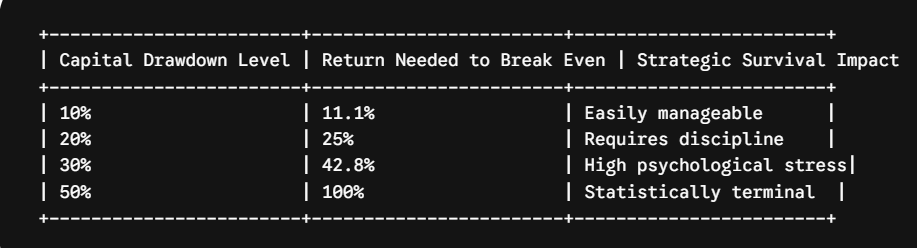
To insulate your wealth from severe market shocks, your risk rules must be completely non-negotiable. Enforce a strict position sizing rule where you never risk more than 1% to 2% of your total trading capital on any single setup. Your maximum position size must always be calculated mathematically before you route an order:

Never employ a fixed percentage stop-loss that completely ignores the structural realities of the chart. The market respects technical support zones, not your personal account math. For an exhaustive breakdown on implementing rigid daily drawdown limits, managing SEBI’s upfront peak margin obligations, and using Average True Range (ATR) to set stops that survive noise, study the 11 concrete rules mapped out in “how-to-manage-risk-in-the-indian-stock-market–11-rules_5.pdf”.
Step 4: Generating Active Income to Fuel Compounding Portfolios
While long-term fundamental investing is the vehicle that ultimately preserves and compounds generational wealth, short-term intraday or swing trading serves as a powerful generator of active cash flow. However, to extract consistent daily profits from the National Stock Exchange (NSE), you must manage transaction frictions ruthlessly. Brokerage fees, Securities Transaction Tax (STT), exchange charges, and GST can easily consume over half of an active scalper’s gross profits if their targets are too tight.
To beat this cost structure, professional short-term operators filter their tracking watchlists down exclusively to highly liquid, large-cap names like HDFC Bank, Reliance, or SBI, using Volume Weighted Average Price (VWAP) and the Relative Strength Index (RSI) to capture explosive momentum breakouts.
For a comprehensive framework on screening for liquid tickers each morning, using volume expansion filters, and structuring an active trading plan that keeps transaction costs manageable, refer directly to the methods detailed inside “how-to-build-consistent-intraday-trading-profits-in-india_5.pdf”. True riches occur when you take the systematic cash flow generated from disciplined, active trading and consistently reallocate those profits into long-term equity investments, allowing compounding to run undisturbed for decades.
Step 5: How to Select an Elite Academy in Delhi NCR
If you are located in the capital region and searching for a premier stock market course in delhi, you must look past shiny marketing brochures and lifestyle promises. You need to perform a rigorous audit of the institution’s structural standards.
A high-quality stock market course in delhi must be anchored by verifiable faculty credentials. Demand to see valid certifications from the National Institute of Securities Markets (NISM)—specifically Series VIII for Equity Derivatives and Series XV for Research Analysts. Furthermore, the academy must feature dedicated live-trading hours where students actively apply chart setups on live market feeds during the actual 9:15 AM to 3:30 PM session.
An exceptional example of these rigorous standards in practice is the Trading Smart Edge (TSE) Institute in Pitampura. Rather than providing students with recycled online presentations, TSE pairs students with active market traders, offers transparent itemized fee structures, embeds comprehensive NISM certification preparation into the syllabus, and provides lifetime post-course backup support.
Before committing your capital to any educational program, ensure it meets the extensive operational benchmarks detailed inside “how-to-choose-a-reliable-trading-academy-in-delhi-ncr_5.pdf”. If an institution hesitates to let you speak with an active trader or sit in on a live-market demo session, they do not deserve your enrollment.
Your Step-by-Step Blueprint to Market Riches
To transition from an uneducated retail spectator into a highly disciplined, wealthy market professional, implement this exact operational sequence:
Build Technical Fluency: Meticulously study candlestick structures, support bands, and trend metrics without exposing real money.
Commit to Strict Simulators: Utilize real-time simulators like StockGro or TradingView virtual funds to prove you can maintain positive expectancy across 50 consecutive mock trades.
Secure Certified Mentorship: Stop guessing in the dark. Enroll in a certified, high-density stock market course in delhi that prepares you for formal regulatory certifications and provides real-time terminal exposure.
Enforce Hard Drawdown Breakers: Install strict terminal boundaries. If your account hits a 3% drawdown limit in a single session, close the platform instantly to protect your emotional capital.
Maintain an Exhaustive Journal: Log the exact entry, exit, position size, and emotional trigger of every position. Review your metrics every single weekend to cut underperforming strategies ruthlessly.
Take Absolute Control of Your Capital
The stock market remains the single greatest wealth-transfer mechanism ever created. However, it is designed to systematically transfer capital away from the impatient, uneducated gambler and deliver it directly into the pockets of the disciplined, rules-based professional. Becoming rich here is not a myth, but it requires the exact same patience, education, and humility as medicine, law, or engineering.
To expand your macroeconomic perspective before your next live position, study how corporate earnings seasons, institutional money flows, and global indices shift local trends by reading our master guide on how to read financial news and market analysis. Stop relying on unverified internet tips. Commit to structured education, select a top-tier stock market course in delhi that prioritizes live-market execution, and allow your systematic discipline to translate into life-changing generational wealth.