You open your brokerage app on a Thursday morning. You navigate away from the comforting, familiar screens of your regular equity portfolio and click on a tab labeled “Options Chain.”
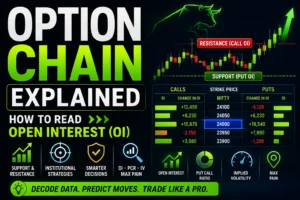
Instantly, you are hit by a wall of chaotic data.
Columns of rapidly fluctuating numbers. Strange financial jargon like “Strike Price,” “Open Interest,” and “Implied Volatility.” Bizarre Greek letters like Theta, Delta, and Vega. It looks less like a financial market and more like the raw green code from The Matrix.
Intimidated, you close the app. You tell yourself that the Futures and Options (F&O) segment is strictly reserved for Wall Street quantitative analysts, mathematical geniuses, or reckless gamblers looking to lose their life savings.
Let us destroy that illusion right now.
The mechanics behind call and put options are not inherently complicated. The financial industry simply hides remarkably straightforward concepts behind walls of dense, intimidating vocabulary. At their absolute core, options are just simple contracts. They are agreements made between two people about the future price of an asset. That is it.
If you have ever negotiated to buy a piece of real estate, or if you have ever purchased an insurance policy for your car, you already fundamentally understand how these derivatives work. You just haven’t learned the terminology yet.
This comprehensive guide is going to tear down the complexity of the derivatives market. We will translate the chaotic numbers of the options chain into plain, everyday language. By the time you finish reading, you will understand exactly how to leverage these powerful financial instruments to generate yield, protect your long-term portfolio, and execute high-probability setups without blowing up your capital.
Quick Answer
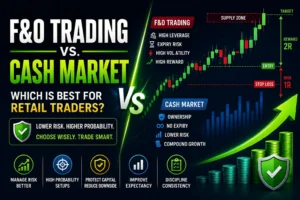
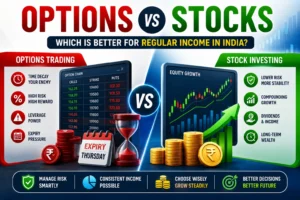
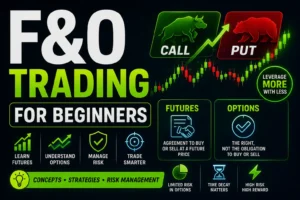
| The Core Definition: Options are financial contracts that give you the right, but not the obligation, to buy or sell an underlying stock or index at a specific price on a specific date. The Difference: You buy call and put options based on your market direction. A “Call” option is purchased when you believe the market will go up. A “Put” option is purchased when you believe the market will go down. The Risk Factor: Option buyers have limited risk (you can only lose the premium you pay) but face the severe hurdle of “time decay.” Option sellers have a higher probability of winning but face theoretically unlimited risk if the market moves violently against them. |
The Real Estate Analogy: Demystifying the Jargon
To truly understand how call and put options function on the stock exchange, we must entirely step away from the stock market for a moment. We need a real-world scenario.
Imagine you live in Delhi. You find a beautiful, newly constructed apartment in a rapidly developing neighborhood. The builder is currently asking for ₹1 Crore for the property.
You have done your research. You strongly believe that in the next three months, a major metro station will be announced right next to this building. If that happens, the value of this apartment will instantly skyrocket to ₹1.5 Crores.
However, you don’t have ₹1 Crore in your bank account today. Furthermore, you don’t want to take out a massive bank loan just in case your prediction about the metro station turns out to be wrong.
So, you approach the builder with a creative proposition.
You offer the builder a non-refundable token advance of ₹2 Lakhs. In exchange for this token, the builder signs a legal contract. The contract states that you have the exclusive right to buy this exact apartment for ₹1 Crore, anytime within the next three months. The builder is legally locked in. Even if property prices explode, they cannot sell the apartment to anyone else, and they cannot raise the price on you.
Scenario A: Your Prediction is Correct
Two months later, the government officially announced the new metro station. The market value of the apartment immediately jumps to ₹1.5 Crores.
You exercise your legal contract. You buy the apartment from the builder for the agreed-upon ₹1 Crore. You immediately turn around and sell it on the open market for ₹1.5 Crores.
You just made a massive ₹50 Lakh profit, all from an initial risk of only ₹2 Lakhs. That is the incredible power of financial leverage.
Scenario B: Your Prediction is Wrong
Three months have passed. The government announces that the metro station project has been permanently canceled. The real estate market in the area cools down, and the apartment is now only worth ₹80 Lakhs.
Are you forced to buy the apartment for ₹1 Crore? Absolutely not.
The contract gave you the right to buy it, not the obligation. You simply walk away. You let the contract expire. Yes, you lose your ₹2 Lakh token advance, but you are protected from the massive ₹20 Lakh drop in the property’s actual value.
Translating the Analogy to the Stock Market
You just perfectly executed a Call Option. The financial markets use this exact same framework; they just swap out the words. Let’s translate your real estate deal into official Dalal Street terminology:
| The Apartment: This is the Underlying Asset. In the stock market, this could be shares of Reliance, HDFC Bank, or the broader Nifty 50 Index. The ₹1 Crore Price Tag: This is the Strike Price. It is the pre-agreed price at which you can buy or sell the asset. The ₹2 Lakh Token Advance: This is the Option Premium. It is the non-refundable fee the buyer pays to the seller to purchase the contract. The Three-Month Deadline: This is the Expiration Date (or Expiry). In India, options contracts expire on a fixed schedule (typically weekly for indices and monthly for individual stocks). |
Once you understand this foundational real estate analogy, the seemingly complex world of call and put options begins to look incredibly logical.
What Exactly Are Call Options? (Betting on the Upside)
Let’s dive deeper into the specific mechanics of the first half of the derivatives equation.
A Call Option is a contract that gives the buyer the right to purchase a specific stock or index at a predefined Strike Price before the Expiration Date. You buy a Call when your technical or fundamental analysis indicates that the underlying asset is about to experience a bullish surge.
The Mechanics of a Call Trade
Assume shares of Tata Motors are currently trading at ₹1,000 on the open market. You have thoroughly reviewed a reliable beginner’s guide to technical analysis in India and spotted a massive “Bullish Engulfing” candlestick pattern on heavy volume. Your analysis suggests Tata Motors will surge to ₹1,100 within the next few weeks.
Instead of buying 1,000 physical shares (which would require ₹10,00,000 in capital), you look at the options chain.
You find a Tata Motors Call Option with a Strike Price of ₹1,020, expiring at the end of the month. The Option Premium (the price to buy the contract) is ₹20 per share. Options are sold in fixed “lots.” Let’s say the lot size is 1,000 shares.
You pay a total premium of ₹20,000 (₹20 x 1,000 shares).
The Payoff: If Tata Motors violently rallies to ₹1,100 before expiry, your right to buy those shares at the locked-in price of ₹1,020 becomes incredibly valuable. The option premium will skyrocket. You can sell the contract back to the market for a massive percentage gain.
If Tata Motors drops to ₹900, your contract is worthless. Why would you exercise a right to buy shares at ₹1,020 when you could just buy them on the open market for ₹900? You let the contract expire, and your maximum loss is strictly capped at the ₹20,000 premium you paid.
This asymmetric risk profile defined, limited downside with theoretically unlimited upside is why beginners are so aggressively drawn to buying calls.
What Exactly Are Put Options? (Betting on the Downside)
If a Call Option is a token advance on a house, a Put Option is an insurance policy on your car.
A Put Option is a contract that gives the buyer the right to sell a specific stock or index at a predefined Strike Price before the Expiration Date. You buy a Put when you believe the market is about to crash, or when you want to protect your existing long-term portfolio from a sudden macroeconomic shock.
The Mechanics of a Put Trade
Let us look at a defensive scenario. You own a massive portfolio of Indian banking stocks. You are reading the macroeconomic data and realize the Reserve Bank of India (RBI) is likely to unexpectedly hike interest rates, which historically crushes banking equities. You are terrified the Bank Nifty index is going to plummet.
However, you don’t want to sell your long-term stocks and trigger massive capital gains taxes. Instead, you buy insurance.
You purchase a Put Option on the Bank Nifty. Let’s say the index is at 46,000. You buy a 45,500 Strike Price Put Option, paying a premium.
The Payoff: If the RBI hikes rates and the Bank Nifty violently crashes down to 44,000, your long-term stock portfolio will bleed red. But look at your Put Option. You hold a legal contract giving you the right to sell the index at 45,500, even though the actual market value is only 44,000.
Your Put Option becomes incredibly valuable. The massive profits you generate from selling the Put Option offset the temporary paper losses in your stock portfolio. This strategy is known as “Hedging.”
Conversely, if you are simply a speculator who wants to profit from a falling market without actually owning the underlying shares, buying puts allows you to short the market with strictly defined risk. You cannot lose more than the premium paid.
The Buyer vs. The Seller: A Game of Risk and Probabilities
This is the exact juncture where most beginners completely blow up their trading accounts. When learning about call and put options, novices assume that buying these contracts is the only way to participate in the market.
They forget a fundamental rule of capitalism: for every buyer, there must be a seller.
When you pay a ₹20,000 premium to buy a Call Option, who exactly is collecting that money? It is an Option Seller (also known as an Option Writer). The dynamics between buyers and sellers dictate the entire flow of the derivatives market.
The Option Buyer (Limited Risk, Low Probability)
As we established, when you buy call and put options, your risk is absolutely floored. You can never lose more than the premium you paid. You sleep easily at night knowing your downside is mathematically capped.
However, the market extracts a severe penalty for this safety. The probability of an option buyer winning a trade is historically low, often hovering around 30% to 35%. Why? Because for a buyer to win, the market must move aggressively in their chosen direction, and it must do so before a specific deadline. If the market goes sideways and does absolutely nothing, the option buyer loses all their money to time decay.
The Option Seller (Unlimited Risk, High Probability)
Option selling is the playground of massive institutional funds and elite proprietary traders. When an institution writes a contract, they collect the premium upfront. They act as the insurance company.
The probability of an option seller winning is incredibly high, often above 65%. A seller wins if the market moves in their favor. A seller also wins if the market goes completely sideways. A seller even wins if the market moves slightly against them, as long as it doesn’t breach the strike price.
But there is a terrifying catch. The option seller faces theoretically unlimited risk. If an institution sells a naked Call Option, and the stock unexpectedly gaps up 20% on positive earnings news, the seller must cover the immense difference out of their own pocket. This is why the Securities and Exchange Board of India (SEBI) mandates massive margin requirements for option sellers, often requiring lakhs of rupees just to write a single lot.
If you are stepping into this arena, understanding how to balance these asymmetrical odds is vital. Implementing an unyielding system for managing risk in the Indian stock market is not optional; it is the absolute baseline for survival.
Understanding “Moneyness” in Call and Put Options
When you stare at an options chain on the National Stock Exchange portal, you will notice that the premiums for different strike prices vary wildly. Some contracts cost ₹500, while others cost ₹5.
This pricing discrepancy is determined by a concept called “Moneyness.” It describes the relationship between the current market price of the asset (the spot price) and the Strike Price of your contract.
Every single contract in the universe of call and put options falls into one of three distinct categories:
1. In The Money (ITM)
An option is ITM if the contract already possesses intrinsic, tangible value.
| For a Call: The Strike Price is lower than the current market price. (e.g., You have the right to buy Reliance at ₹2,800, but it is currently trading at ₹2,900. Your contract is inherently worth at least ₹100). For a Put: The Strike Price is higher than the current market price. |
ITM options are highly expensive to purchase because they already hold real value. They behave very similarly to owning the actual stock.
2. At The Money (ATM)
An option is ATM when the Strike Price is exactly identical (or incredibly close) to the current market price of the asset.
If Nifty 50 is trading at 22,500, the 22,500 Call and the 22,500 Put are ATM. These contracts are highly sensitive to market movements and carry a massive amount of speculative time value.
3. Out of The Money (OTM)
An option is OTM if it currently holds absolutely zero intrinsic value. It is a pure gamble on the future.
| For a Call: The Strike Price is higher than the current market price. (e.g., Buying a ₹3,200 Call on Reliance when the stock is at ₹2,900). For a Put: The Strike Price is lower than the current market price. |
OTM options are incredibly cheap. They cost mere pennies. This is why beginners flock to them, hoping to turn ₹5,000 into ₹50,000 overnight. Here is the brutal truth: the vast majority of OTM options expire completely worthless. Buying deep OTM options is the fastest known method for vaporizing a retail trading account.
The Hidden Forces: Introducing the Option Greeks
You cannot master call and put options by only looking at the price chart of the underlying stock. Options are derivatives, which means their pricing models are governed by a complex set of mathematical variables.
You do not need a PhD in advanced calculus to trade, but you absolutely must understand the “Option Greeks.” These are the silent, invisible forces pushing and pulling the value of your premium.
Delta: The Speedometer
Delta measures how much your option premium will increase or decrease for every ₹1 move in the underlying stock. If you own a Call Option with a Delta of 0.50, and the underlying stock goes up by ₹10, your option premium will increase by ₹5. ITM options have high Deltas (moving almost 1-to-1 with the stock), while deep OTM options have tiny Deltas (barely reacting to stock movement).
Theta: The Silent Killer
If you are an option buyer, Theta is your ultimate enemy. Theta measures “Time Decay.” Options are melting ice cubes. Every single day that passes brings the contract closer to its expiration date. As time bleeds away, the probability of the option hitting its target drops. Theta dictates exactly how much money your option will lose every single day, even if the stock price does not move a single inch. This is why buying options in a sideways, stagnant market guarantees a total loss.
Vega: The Volatility Engine
Have you ever bought a Call Option before a major corporate earnings announcement, watched the stock go up exactly as you predicted, but your option actually lost money? You were crushed by Vega.
Vega measures the impact of “Implied Volatility” (IV). When the market is terrified of an upcoming event (like the national budget or an election), panic sets in. Insurance gets expensive. Option premiums artificially inflate because of high IV. Once the event passes and the fear vanishes, IV collapses violently. The premium deflates instantly, crushing retail buyers who bought at the peak of the panic.
If you aim to execute these highly complex, multi-variable derivatives effectively during fast market opens, mapping out your daily strategy using comprehensive guides on building consistent intraday trading profits will help you survive the violent swings of the Greeks.
Why Trade Call and Put Options Anyway?
Given the complexities of Theta decay and Implied Volatility, why do professionals bother navigating the derivatives landscape instead of just buying simple cash equities?
The answer lies in the sheer architectural flexibility that call and put options provide. They are the ultimate financial multi-tools.
1. Supreme Capital Leverage
As demonstrated in our real estate analogy, options allow you to control massive amounts of underlying capital using only a fraction of the actual cash. You can capture the percentage gains of 1,000 shares of an IT giant by only deploying 5% of the capital required to buy those shares outright. This leverage, when managed with clinical risk parameters, accelerates wealth compounding drastically.
2. Generating Passive Yield
Remember the institutional option sellers? Retail investors can play that game too. If you own a large, long-term portfolio of high-quality stocks, you can execute a strategy called a “Covered Call.” You actively sell OTM Call Options against your own portfolio, collecting the premium upfront as cold, hard cash. It acts as a synthetic dividend, generating steady monthly yield regardless of whether the broader market trends upward.
3. Omnidirectional Profitability
An equity investor can only make money if the market goes up. If a severe recession hits, they are forced to sit on their hands and watch their net worth bleed.
A master of call and put options is completely indifferent to market direction. If the market is bullish, they deploy Call spreads. If the market crashes violently, their Put options explode in value. If the market gets stuck in a stagnant, sideways range for three months, they deploy “Iron Condors” to collect Theta decay. They extract capital in all market environments.
The Dark Side of F&O: Risks You Cannot Ignore
We must pause here to inject a heavy dose of reality. The financial media frequently glorifies the massive wins associated with derivatives, but they conveniently ignore the silent graveyard of destroyed retail accounts.
Trading call and put options without a formalized structural education is financial suicide.
When you purchase naked, short-term options, you are fighting a multi-front war. You have to be right about the direction of the market. You have to be right about the magnitude of the move. And you have to be right about the exact timing of the move. If you fail on any one of those three variables, your entire premium goes to zero.
A highly publicized study by SEBI confirmed that 9 out of 10 individual traders in the equity F&O segment incur net losses. They lose because they operate on primal emotion—fear, greed, and the desperation to recover previous losses. They average down on collapsing options, completely ignoring the relentless bleed of Theta.
You cannot outsmart the algorithms using hope. You must build an unyielding system. If you are serious about surviving this arena, do not rush in blindly. Submitting yourself to the rigors of a structured 8-week plan to learn stock trading will construct the psychological barriers you need before real capital is placed on the line.
How to Start Trading Options in India
If you have weighed the risks and are genuinely prepared to approach derivatives with the cold, calculated discipline of an institutional operator, here is your execution roadmap.
Step 1: Secure an F&O Enabled Brokerage Account
You cannot trade derivatives on a standard cash-delivery account. You must log into your discount broker (like Zerodha, Upstox, or Groww) and specifically activate the F&O segment. SEBI requires brokers to verify your financial stability before granting access. You will need to upload an income proof document, such as a recent 6-month bank statement, your latest ITR acknowledgment, or your most recent corporate salary slip.
Step 2: The Mandatory Sandbox Runway
This is non-negotiable. Do not fund your live terminal immediately. You must spend a minimum of four weeks operating inside a paper-trading sandbox.
Use platforms like Sensibull or virtual trading apps to execute simulated options strategies. You must debug your mechanical platform skills. Learn how to construct a multi-leg hedge, how to place stop-loss brackets on rapidly decaying premiums, and how to track the Greeks without freezing under pressure.
Step 3: Seek Out Live-Market Mentorship
Reading articles online is a fantastic starting point, but theory shatters upon contact with live market velocity. The fastest, safest way to bypass the expensive trial-and-error phase is to learn directly from active market practitioners.
Do not waste time on fake gurus selling recorded slideshows. If you are located in the NCR region, search for physical facilities with dedicated live trading labs where you can watch professionals execute order flow in real-time. For an uncompromised checklist on how to vet these academies, utilizing our diagnostic framework on choosing a reliable trading academy in Delhi NCR will protect you from predatory marketing traps.
Step 4: Go Live with Micro-Capital
When you finally transition to live execution, fund your account with a tiny amount of risk capital—money you could comfortably afford to set on fire without losing a minute of sleep. Trade in single lots. Focus entirely on the flawless execution of your technical process, not on the monetary outcome. Only scale up your position sizing after you have accumulated three consecutive months of verified, positive mathematical expectancy in your trade journal.
Final Thoughts: Respect the Derivative
The Indian macroeconomic engine is currently operating at a scale unseen in modern history. The sheer volume of retail and institutional liquidity pouring into the National Stock Exchange has created a derivatives ecosystem that is deep, highly efficient, and bursting with opportunity.
Understanding the mechanics of call and put options elevates you from a passive passenger hoping the market goes up, into a tactical operator capable of extracting yield in any economic climate.
But you must approach this arena with absolute respect. Options are high-performance power tools. In the hands of a skilled, disciplined artisan, they can build architectural masterpieces of compounding wealth. In the hands of an untrained, emotional amateur, they will violently tear a portfolio to shreds.
Strip away the noise. Stop looking for magical shortcuts or hot social media tips. Learn the mathematics of the Greeks, respect the brutal reality of time decay, and cage your primal emotions behind strict risk firewalls. The complex matrix of the options chain will stop looking like chaos, and it will finally reveal itself for what it truly is: a landscape of limitless, calculated opportunity.