The psychological architecture of the human mind is poorly engineered for the modern financial grid. We are hardwired by evolution to seek instant rewards, look for rapid patterns, and react to sudden visual threats. This caveman programming served us brilliantly when surviving predators in a physical wilderness, but it acts as a silent destroyer of wealth when navigating the modern equity markets. Every morning across the country, millions of retail participants log into their sparkling new brokerage apps. They watch flashing neon numbers, feel a surge of pure dopamine, and succumb to an overwhelming urge to execute. They buy a stock on a whim because an online influencer posted a screenshot, read a panicked macroeconomic tweet two hours later, and liquidate their position by afternoon. They mistake frantic, stress-fueled activity for actual financial progress.
The reality of true wealth creation is entirely counterintuitive. It is a slow, methodical, and occasionally deeply boring exercise in extreme psychological discipline. When you look at the economic trajectory of the country—a nation undergoing a historic structural transformation driven by an explosive tech sector, digital public infrastructure, and a massive shift in household savings—the macro tailwinds are undeniable. Yet, the vast majority of retail participants will fail to capture this generational growth. They will wash out not because the market is a rigged game, but because they treat an arena designed for patient compounding like a short-term casino terminal. If you are going to put your hard-earned capital at risk, you must rise above this speculative noise. You must transition from a chaotic speculator into a highly structured market participant. This is your definitive blueprint to cross that bridge, find the best stocks to invest in india, and build an unshakeable wealth portfolio.
Quick Answer: How to Find the best stocks to invest in india
| The Core Thesis: Finding the best stocks to invest in india demands moving completely away from short-term price charts and anchoring your capital in fundamentally dominant businesses that possess unshakeable economic moats and exceptional capital efficiency. The Selection Framework: Look for corporate titans with a rolling ten-year Return on Equity ($ROE$) and Return on Capital Employed ($ROCE$) above 15% to 20%, maintaining low debt profiles, and operating within sectors backed by structural national expansion. The Protective Guardrail: True portfolio longevity requires that you eliminate emotional guessing, diversify across distinct sectors to mitigate systemic shocks, use zero-risk simulation environments to practice execution mechanics, and commit strictly to a long-term holding horizon. |
1. Demystifying the Compounding Machine: What is an Economic Moat?
Before you analyze a single corporate ledger, you must fix a fundamental psychological misconception. A share is not a lottery ticket. It is not a magical digital token that arbitrarily bounces up and down based on the mood of the crowd. This is the most crucial concept within all of long-term wealth creation.
When you purchase a share, you are acquiring a legally binding fraction of an actual, operating business. Your goal is to find businesses that possess deep economic moats. A moat is a structural, intrinsic barrier that protects a company’s profit margins from external competition. In a free-market economy, any business that reports high profits will instantly attract competitors. Capital will rush in, rivals will copy the business model, underplay pricing, and systematically erode the pioneer’s profit margins.
A company with a deep economic moat is structurally immune to this erosion. This defensive barrier can manifest in multiple distinct qualitative forms.
Brand Equity and Consumer Mindshare
Think of companies that dominate consumer psychology. If raw material costs rise due to global inflation, these high-moat consumer firms seamlessly pass the cost increase onto the final consumer. The buyer pays the extra premium without hesitation because the brand is embedded in their daily routine. They do not cross-shop for cheaper generic alternatives because the brand commands absolute trust.
High Switching Costs
Once a major corporate enterprise or bank integrates a specific IT vendor’s software infrastructure into their primary operations, the cost of ripping out that software to save a few thousand rupees is completely irrational. The client is functionally locked into the ecosystem, providing the vendor with highly predictable, multi-year recurring revenue that competitors cannot mathematically steal.
Low-Cost Leadership
Unmatched manufacturing scale and distribution efficiency can drive the cost per unit down to levels that smaller rivals cannot survive. When a corporate giant operates with this scale, they can withstand brutal price wars, maintain profitability, and starve out competition. When searching for the best stocks to invest in india, identifying these structural moats is your very first line of defense.
2. Auditing the Corporate Ledger: The Quantitative Filters
Once you identify a qualitative moat, you must verify its existence on the company’s financial statements. Do not let loud quarterly headlines focusing solely on top-line revenue growth distract your analysis. True compounding machines leave undeniable mathematical tracks on their balance sheets.
Capital Efficiency (ROE and ROCE)
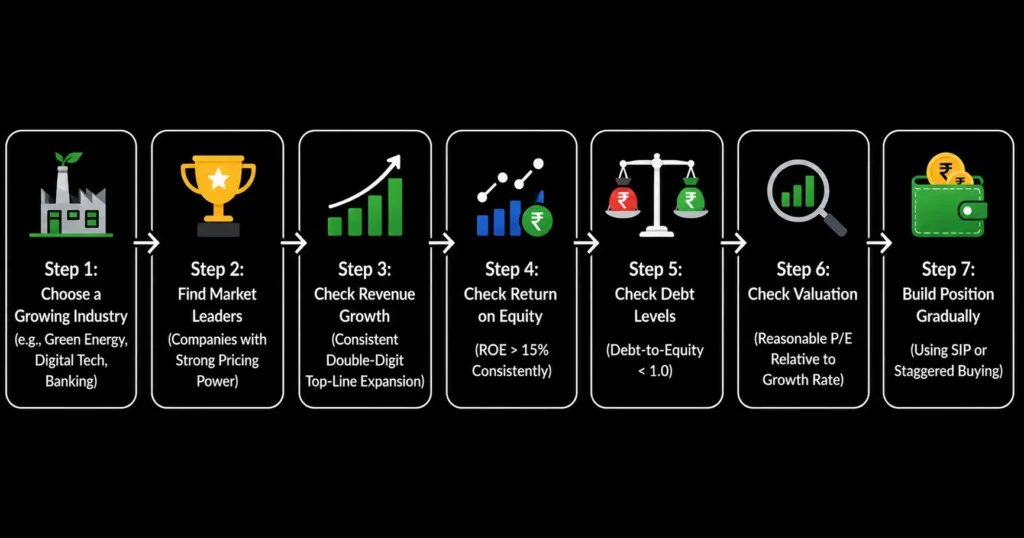
You want to anchor your capital in businesses that demonstrate exceptional efficiency when deploying funds. Focus on the Return on Equity (ROE) and Return on Capital Employed (ROCE). ROE measures exactly how many rupees of net profit a business generates for every hundred rupees of shareholder equity invested.
ROE = {Net Income}{Shareholders’ Equity}
A business that consistently operates with an ROE and ROCE above 15% to 20% over a rolling ten-year horizon is an absolute compounding champion. It proves that the management team possesses the unique capability to reinvest their internal corporate cash flows at high rates of return, expanding your equity value exponentially over time.
The Lethal Weight of Leverage
Ruthlessly avoid heavily indebted companies. Debt is a highly effective financial accelerator during periods of aggressive economic expansion, but it turns into a lethal weight during cyclical contractions or unexpected monetary tightening. High interest obligations eat away at net margins, freeze expansion plans, and expose the business to severe default risks.
Prioritize companies that maintain a Debt-to-Equity ratio below 0.5, or better yet, businesses that operate with a completely net-cash balance sheet. A debt-free business can navigate the most brutal macroeconomic winter, price wars, and global recessions without ever facing liquidation risk. Tracking these strict metrics is fundamental when filtering for the best stocks to invest in india.
3. The Power of Portfolio Diversification: Shielding Against Sector Shocks
The most pristine fundamental research cannot save you if you violate the structural rules of capital allocation. A common mistake among retail beginners is sector concentration. They find a specific industry—such as private banking or information technology—that has delivered spectacular returns over the previous twenty-four months. They experience a surge of pure greed and pack their entire wallet into that single industry.
This is a profound behavioral failure. You are leaving your entire financial destiny exposed to unsystematic, sector-specific shocks.
An unexpected policy shift or regulatory tightening by the Reserve Bank of India (RBI) can instantly devastate the banking sector’s profitability, dragging down your entire net worth simultaneously, even if the broader national economy is growing. To protect your compounding engine, you must spread your capital across distinct, uncorrelated sectors.
The Core Allocation Matrix
A balanced, resilient portfolio should hold positions across at least five to seven separate industrial pillars. Map your capital allocations deliberately across these candidate fields:
- Banking and Financial Services: The primary locomotive of national credit expansion.
- Information Technology: Capturing global enterprise software spend and structural automation waves.
- Consumer Discretionary and FMCG: Grounded in unyielding everyday consumption patterns.
- Healthcare and Pharmaceuticals: Backed by persistent global demographic demands.
- Energy and Infrastructure: Capitalizing on the physical build-out of the country’s logistical corridors.
Never allow a single sector to command more than 20% to 25% of your aggregate equity portfolio. This structural boundary ensures that if an unexpected disaster strikes one specific industry, your other holdings remain insulated, providing a stable foundation to offset the localized drawdown. Spreading your capital this way is an uncompromised rule of safety when seeking the best stocks to invest in india.
4. The Critical Gateway: Demat Vaults and Order Mechanics
You cannot buy a fraction of a business using raw paper cash. You require specialized digital plumbing to route your savings safely to the matching engines of the National Stock Exchange (NSE) and the Bombay Stock Exchange (BSE). To interact with the market, you must open an interconnected dual-account framework through a registered stockbroker.
Your Trading Account is the active interface you log into daily to view charts, analyze order books, and fire execution commands. Your Demat Account is the secure electronic vault where your ownership certificates reside as encrypted data entries.
Crucially, your broker does not store your shares. Your digital assets sit safely inside a highly secure vault managed by massive, central government-regulated depositories—primarily the Central Depository Services Limited (CDSL) or NSDL. Your broker is merely a software viewing window. If your broking application crashes permanently or files for bankruptcy tomorrow morning, your portfolio is entirely safe; you simply map your untouched assets to a new gateway.
Speaking the Language of Order Entry
When you prepare to place a transaction to buy the best stocks to invest in india, your terminal will prompt you to select an execution order type. Deploying the wrong input can cost you dearly.
- Market Orders: You command the broker to buy the stock instantly at whatever the current best available price is on the exchange matching book. In massive blue-chip equities with thick liquidity, this works fine. But in volatile mid-caps, market orders can execute at an unexpected price spike, putting you at an immediate disadvantage.
- Limit Orders: You establish an ironclad price ceiling. You tell the broker, “I want to acquire this stock, but I refuse to pay a single paisa more than ₹500.” The order sits on the book and only executes if the price drops to your exact level, giving you absolute control over your entry pricing.
- Stop-Loss Orders: Your ultimate defensive shield. If you buy a stock at ₹500 hoping it compounds for a decade, you place an automated protective stop-loss order at ₹450. If the market turns hostile, the system automatically sells your position at ₹450, containing your loss to a tiny, calculated paper cut while shielding your core capital.
5. The Great Divide: Trading vs. Investing Identity
The stock market accommodates two entirely separate professions. Blurring the lines between these two disciplines out of emotional panic or confusion is a primary driver of retail losses. Before deploying capital, you must choose your exact operational identity.
The Long-Term Investor
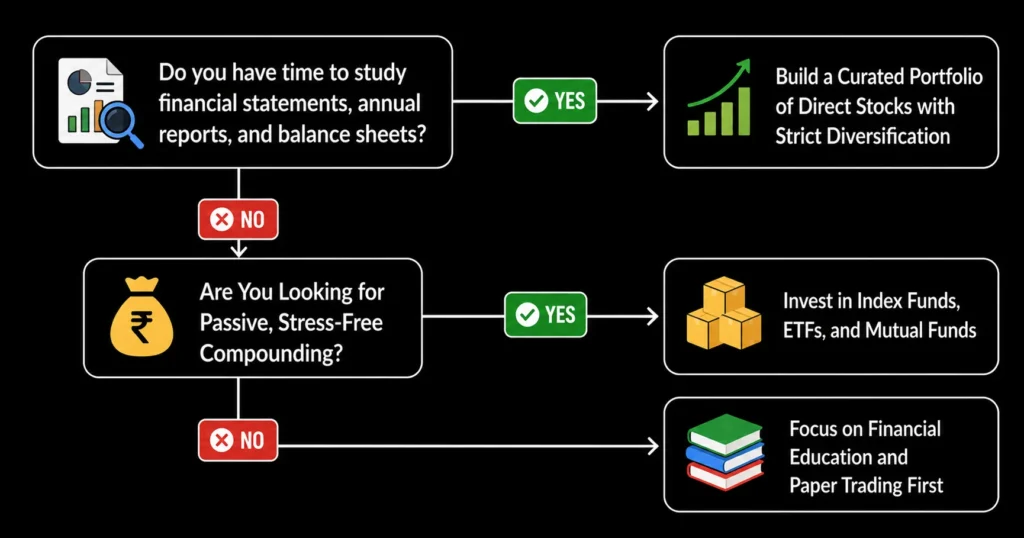
Investing is a passive, fundamentally driven wealth accumulation strategy. An investor views the stock exchange precisely as a mechanism to buy ownership stakes in exceptional businesses. They hold assets for years, if not decades. They rely on the sheer mathematical force of compounding, allowing corporate earnings growth and dividend reinvestments to scale their net worth quietly. They ignore everyday price noise because they understand that over a long horizon, a stock price must inevitably track the underlying business performance.
The Short-Term Trader
Trading is an active, aggressive, and highly demanding career. A trader does not care about a company’s ten-year environmental vision or corporate governance scores. To a trader, a stock ticker is merely a high-velocity digital vehicle used to capture immediate price volatility. They move in and out of positions rapidly, heavily utilizing borrowed capital (leverage) to amplify micro price swings into meaningful returns.
If you attempt to trade with an investor’s patience, you will hold toxic losing positions until your account is wiped out. If you attempt to invest with a trader’s anxiety, you will panic-sell your finest compounding assets during routine market corrections. To see exactly how professional short-term operators structure these high-velocity workflows safely without breaking their risk boundaries, reviewing our master blueprint on how to build consistent intraday trading profits in India provides a sobering look at the necessary discipline. Decide who you are before seeking the best stocks to invest in india.
6. The Role of Technical Timing: Integrating Chart Analysis
Fundamental analysis tells you what business to buy. Technical analysis gives you a clean framework for identifying when to execute your purchase. While a long-term value investor does not need to stare at volatile 5-minute charts all day, developing a basic fluency in chart tracking provides a massive structural advantage. It prevents you from purchasing an elite company at the absolute peak of an irrational, euphoric speculative bubble.
To read chart data cleanly, move away from primitive line charts and switch your display to candlestick charts. A line chart only tracks closing prices, completely hiding the internal battle that occurred during the trading day. A candlestick shows you the complete open, close, high, and low data points within a single visual unit, flashing the true relationship between aggressive buyers and willing sellers.
Locating Institutional Support Zones
Study how price behaves near historical chart structures. Support zones represent demand clusters where massive institutional buying interest has consistently stepped in to halt declining prices. If you load three to six months of daily chart data on a top-tier business, you will notice clear price clusters where the stock has repeatedly bounced higher in the past.
Purchasing shares when a company pulls back into these key structural support zones dramatically reduces your downside risk while optimizing your entry pricing. If you want a deep dive into decoding this visual chart data and structuring a robust morning routine around it, studying a core beginner’s guide to technical analysis in India is an absolute prerequisite before timing your capital entries for the best stocks to invest in india.
7. The Sandbox Strategy: Validating Your Onboarding Mechanics
The most expensive place to discover that you do not accurately understand your broker’s order interface, or that your emotional discipline breaks down under volatility, is a live session using real money. Before risking your actual savings, you must complete an uncompromised forward-testing phase inside a zero-risk sandbox. This is known as paper trading.
Utilize simulated trading terminals or demo platforms that mirror live market data feeds from the Securities and Exchange Board of India (SEBI) regulated exchanges. Treat this virtual capital with identical tactical reverence:
- Calculate Position Sizes Precisely: Run the mathematical calculations for every single simulated trade; do not play with random, oversized blocks out of virtual greed.
- Enforce Every Stop-Loss Trigger: Never manually lower a stop-loss boundary inside a demo application hoping for a sudden bounce; let the terminal close the trade to build structural muscle memory.
- Maintain a Manual Trade Journal: Write down your exact entry triggers, your target multiples, and a brief note describing your emotional state during execution.
Forward testing across two to four weeks exposes exactly where your conceptual understanding breaks down. It allows you to debug your mechanical workflow, build interface confidence, and lock in your protective habits before real money is placed on the line. For individuals seeking a highly structured, week-by-week layout to navigate this transition safely without devastating real-money failures, working through our comprehensive text on the best way to learn stock trading in India through a structured 8-week plan offers an exceptional developmental launchpad for the best stocks to invest in india arena.
8. Defeating the Emotional Spiral: The 2% Capital Boundary
The default state for an unguided retail participant in the stock market is financial loss. The financial press frequently popularizes massive winner screenshots, creating an illusion that generating returns is an effortless endeavor. In reality, the market is an incredibly efficient machine engineered to systematically extract wealth from the chaotic, unstructured speculator and hand it directly to the disciplined operator.
Novice participants almost always wash out because they gamble. They risk outsized portions of their capital on individual, unverified ideas. When a position moves against them, they enter a destructive emotional spiral—over-leveraging their account to average down, cutting their winners too early out of fear, and holding their losers too long out of blind hope.
The Mathematics of Drawdowns
You must respect the brutal asymmetry of capital drawdowns. If your trading portfolio suffers a 10% loss, your remaining capital needs an 11% return just to climb back to your initial break-even baseline. If you allow a few undisciplined trades to inflict a 50% drawdown onto your account, you do not need a 50% return to recover; you need an extraordinary 100% gain purely to get back to zero.
Portfolio Loss % Gain Needed to Break Even
- 10% 11%
- 25% 33%
- 50% 100%
- 75% 400%
Surviving this environment requires the implementation of rigid mathematical boundaries before you place your first live order. The gold standard for capital preservation is the 2% rule. This law mandates that you will never allow a single tactical idea to risk more than 1% to 2% of your total account capital. If you fund your terminal with ₹1,00,000, your maximum allowable rupee loss on a single setup is strictly capped at ₹2,000.
This requirement forces you to calculate your position size mathematically before entry, using the distance between your entry price and your protective stop-loss. It ensures that even a brutal, consecutive string of losses cannot sideline you permanently. To fully master how these protective constraints scale across volatile market cycles, integrating a strict protocol for managing risk in the Indian stock market is an absolute necessity before scanning the horizon for the best stocks to invest in india.
9. Shifting From Online Chaos to Immersive Mentorship
The barrier to entry for the financial markets has been entirely flattened by technology. The fact that any individual can open a secure demat vault on their smartphone and execute transactions from a coffee shop is a true technological miracle. However, this effortless accessibility creates a profound behavioral illusion. Many beginners assume that because they have access to elite software tools, they automatically possess market competency.
They spend months consuming fragmented, ad-hoc video content online, patching together random technical indicators they do not understand, and wondering why their accounts leak capital during live hours. Free online content can give you raw definitions; it cannot provide personal accountability, real-time correction, or the experience of making decisions under live pressure. It takes a solo beginner hundreds of painful real-money losses to recognize the behavioral blind spots that an expert can identify in a single afternoon.
The difference between achieving consistency in a few months versus spending years churning your capital often comes down to the quality of the feedback loop you build during your development phase. Having active market practitioners review your execution logs, critique your technical charts, and correct your strategic errors in real time saves you months of preventable drawdowns.
For aspiring investors and traders operating across the Delhi-National Capital Region (NCR) who wish to escape the trial-and-error cycle of solo trading, transitioning into a physical, mentor-led environment is a profound structural upgrade. This is precisely why specialized hubs like the Trading Smart Edge (TSE) Institute in Pitampura, Delhi operate.
Rather than leaving independent investors to navigate dangerous traps alone, a professional training curriculum pairs students with active market practitioners inside live-market training rooms. Beginners learn to design robust trade plans, evaluate corporate moats, prepare for industry certifications, and receive immediate corrective feedback on strategic errors before their capital is damaged.
Learning how to properly evaluate an educational institute is a key skill for any serious participant. If you want a clear checklist to assess coaching quality across the region, reading our comprehensive strategic guide on how to choose a reliable trading academy in Delhi NCR breaks down the exact credentials and criteria to look for before enrolling your time and resources to find the best stocks to invest in india.
10. Your Long-Term Execution Roadmap: A Verification Checklist
As you prepare to transition from theoretical literacy into active market participation, remember that wealth creation is a long-term discipline. Do not fund your account today with an expectation of generating extraordinary returns by next Friday. Approach the arena with deep humility, protect your downside with ruthless discipline, and let the structural trajectory of the country’s economic expansion compound your capital systematically.
Before you authenticate your primary bank link and place your very first long-term transaction, pass your workspace through this final operational verification checklist to guarantee your system is completely optimized for finding the best stocks to invest in india:
The Final Pre-Flight Verification Checklist
- Link a Secure Mobile Gateway: Verify that your legal identification documents, broker portal, and bank account are synchronized to a singular, active phone number utilizing robust two-factor authentication ($2FA$). Meticulously protect your login pins and access codes.
- Confirm Your Nominal Beneficiary: Ensure you explicitly assign a legal nominee during your account configuration phase. This protects your family from agonizing bureaucratic hurdles if your wealth assets ever need to be securely transferred to your heirs.
- Audit the Tax Ledger Tooling: Verify that your chosen broking platform features an advanced, clean capital gains reporting engine. Come tax season, you will need an interface that breaks down short-term capital gains, long-term holdings, and business turnovers smoothly without calculation bugs.
- Verify the Electronic Delivery (e-DIS) Mandate: Establish your central TPIN framework immediately upon account activation. This allows your terminal to digitally authorize delivery sell transactions securely without processing stalls, completely eliminating legacy paper processing while securing your assets from unauthorized movement.
The retail financial ecosystem in India is navigating an unprecedented structural golden age. The capital market efficiency, charting precision, and low transactional barriers accessible on your smartphone terminal today were completely unavailable to elite institutional fund desks twenty years ago. The tools of wealth creation have been entirely democratized, completely free of traditional entry barriers. Choose the platforms that perfectly align with your current lifestyle and cognitive wiring, wrap your execution parameters inside unyielding risk boundaries, and select the best stocks to invest in india to let your wealth compound systematically. The gateway is completely optimized; execute with absolute care.