
Quick Answer: While ChatGPT can process financial statements, summarize annual reports, and analyze data in seconds, it is not a replacement for human stock analysts. AI serves as a powerful research assistant, but human analysts still hold the advantage in evaluating management integrity, corporate governance, and complex qualitative strategy. The most effective approach for retail investors is combining AI speed with human judgment.
Introduction
Artificial intelligence is transforming nearly every industry, and financial research is no exception. Walk onto any trading floor or browse retail investing forums today, and you will find a fierce debate: Can an advanced language model like ChatGPT outperform traditional human stock analysts?
As more investors turn to generative AI to screen stocks, summarize earnings reports, and interpret market trends, understanding the strengths and limitations of both sides has never been more crucial. Can AI really outperform human expertise? In short, AI excels at data processing and speed, but human intuition, emotional intelligence, and strategic context remain irreplaceable. This guide explores how ChatGPT compares to human stock analysts and how modern investors can harness both for smarter decision-making.
What Is ChatGPT and How Does It Analyze Stocks?
ChatGPT is a generative artificial intelligence model powered by deep learning and natural language processing. It is designed to understand human text, process large volumes of data, and generate coherent, contextual responses.
- How AI Processes Financial Data: By feeding annual reports, quarterly earnings filings, and financial statements into ChatGPT, users can instantly extract key metrics, revenue growth rates, and expense trends.
- News & Ratio Interpretation: AI can scan thousands of global news articles in seconds to summarize market sentiment and calculate valuation ratios when provided with raw data.
What ChatGPT Can Do
- Summarize lengthy 100-page annual reports and earnings transcripts.
- Explain complex financial concepts, valuation ratios, and accounting terms.
- Compare financial metrics between multiple companies side by side.
- Assist with initial stock screening and data organization.
What ChatGPT Cannot Do
- Access real-time insider insights or attend private corporate management meetings.
- Guarantee 100% factual accuracy (AI models can occasionally hallucinate data).
- Make independent financial decisions or accept liability for investment losses.
- Understand your personal financial goals, risk appetite, or emotional triggers.
What Does a Stock Analyst Actually Do?
Professional stock analysts working for brokerages, mutual funds, and institutional research desks perform deep, comprehensive evaluations to determine a company’s intrinsic value.
- Fundamental Analysis: Examining core business health, revenue streams, profit margins, and balance sheet strength.
- Industry Research: Analyzing sector tailwinds, regulatory changes, and competitive positioning within the broader market.
- Financial Modelling: Building complex discounted cash flow (DCF) models to forecast future earnings under various economic scenarios.
- Earnings Forecasting: Projecting quarterly and annual revenue expectations based on management guidance and macro trends.
- Company Valuation: Determining whether a stock is overvalued, undervalued, or fairly priced.
- Management Analysis: Evaluating promoter integrity, corporate governance track records, and capital allocation decisions.
- Sector Research: Conducting site visits, speaking with suppliers, and analyzing supply chain logistics firsthand.

ChatGPT vs. Stock Analysts – Side-by-Side Comparison
| Feature | ChatGPT | Human Analyst |
| Speed | Instant (Seconds) | Days or weeks of research |
| Cost | Extremely low / Free tiers available | High (Salary / Institutional research fees) |
| Data Processing | Massive volumes of unstructured text | High analytical depth |
| Emotional Bias | Zero (Purely mathematical/textual) | Subject to behavioral and confirmation biases |
| Market Experience | None (Trained on historical data) | Years of real-world market cycles |
| Company Meetings | None (Cannot attend earnings calls or factory visits) | Direct access to management and industry experts |
| Scalability | Infinite (Can analyze thousands of stocks simultaneously) | Limited by time and bandwidth |
| Personal Judgment | Lacks subjective intuition | High contextual judgment |
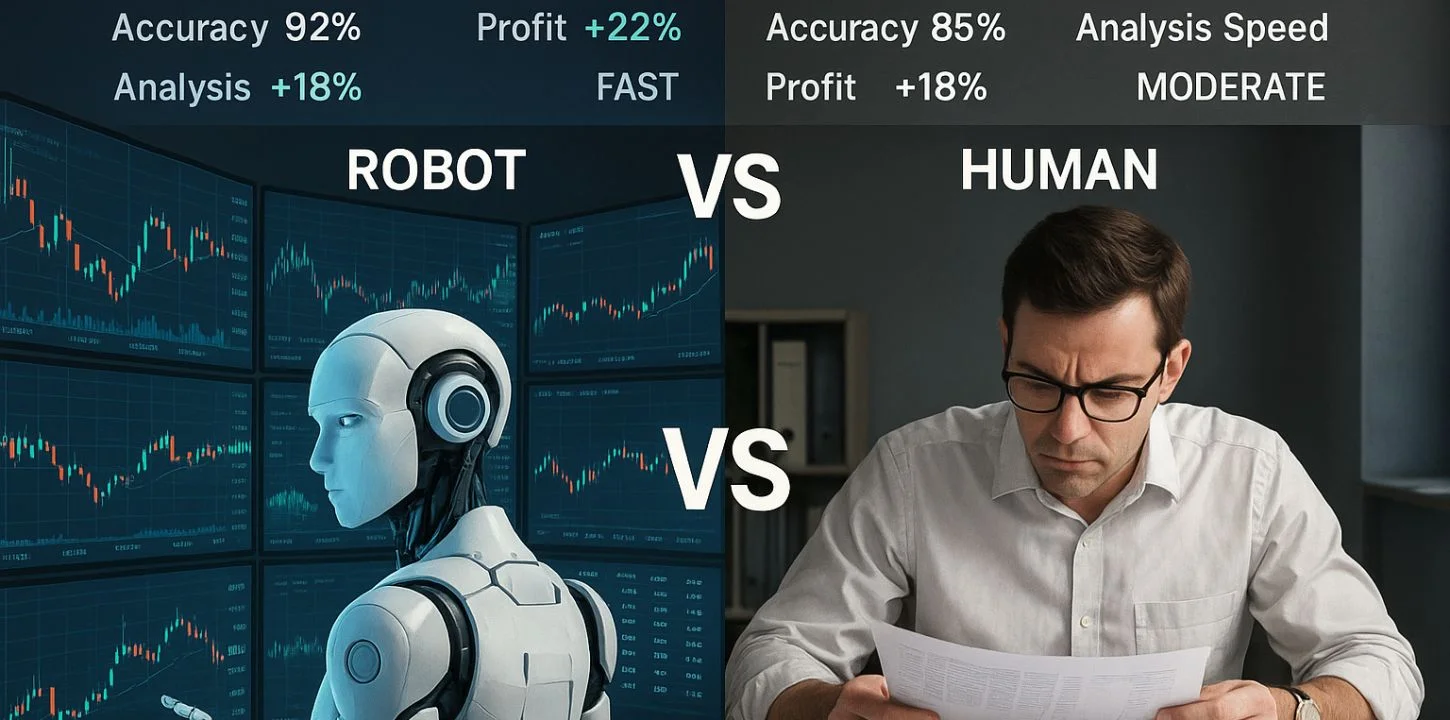
Can ChatGPT Really Pick Better Stocks?
Academic studies and fintech experiments evaluating AI stock-picking capabilities reveal nuanced findings:
- Academic Findings: Tests where AI models selected stocks based on technical indicators and sentiment analysis have occasionally generated respectable short-term returns, outperforming random index selection in specific momentum phases.
- Why AI Performed Well: Algorithms excel at scanning massive datasets without emotional hesitation, quickly identifying undervalued companies or oversold technical bounces based on historical rules.
- Where AI Struggled: AI models often falter during black-swan events, sudden regulatory changes, or structural shifts in business models where historical training data offers no precedent.
- Interpretation: Results must be interpreted carefully. AI is a tool for pattern recognition and data summarization, not a crystal ball that guarantees market outperformance.
Advantages of Using ChatGPT for Stock Analysis
- Faster Research: Condense hours of reading into a few minutes by asking ChatGPT to extract specific financial metrics.
- Financial Statement Analysis: Quickly break down complex income statements and balance sheets.
- Earnings Summary: Get concise bullet-point summaries of quarterly conference calls immediately after release.
- Company Comparison: Compare competitor metrics across margins, debt-to-equity ratios, and return on equity (ROE).
- Stock Screening: Generate initial screening criteria for further fundamental evaluation.
- Learning Investment Concepts: Clarify complex financial terminology instantly while studying the markets.
- Build a strong foundation before leveraging advanced tools with our Share Market Basics & Investing Guide.
Where Human Stock Analysts Still Have the Advantage
- Corporate Governance: Assessing the moral integrity and transparency of corporate boards—something financial statements alone cannot reveal.
- Management Quality: Evaluating leadership execution through body language on earnings calls, past capital allocation history, and strategic vision.
- Industry Experience: Veteran analysts possess intuition built from surviving multiple market crashes and economic cycles.
- Competitive Landscape: Understanding subtle nuances in local market competition and supplier relationships.
- Business Strategy: Evaluating whether a company’s long-term pivot or acquisition strategy will succeed in a shifting economy.
- Regulatory Changes: Interpreting shifting government policies and legal hurdles before they impact earnings.
- Economic Interpretation: Synthesizing complex geopolitical events into actionable portfolio adjustments.
Limitations of ChatGPT for Investing
- No Guaranteed Accuracy: AI models can generate plausible-sounding incorrect data (hallucinations), which can be dangerous if relied upon blindly.
- No Future Prediction: AI analyzes past patterns; it cannot foresee disruptive innovations or sudden market crashes.
- Depends on Available Data: If underlying financial filings contain accounting manipulation, ChatGPT will process the flawed data without knowing the difference.
- Cannot Replace Independent Research: AI is an assistant, not a substitute for personal due diligence.
- Doesn’t Understand Personal Financial Goals: ChatGPT does not know your risk tolerance, liquidity needs, or investment horizon.
How Retail Investors Can Use ChatGPT Wisely
- Step 1: Understand the core business model of the company you are researching.
- Step 2: Ask ChatGPT to summarize key line items from recent balance sheets and income statements.
- Step 3: Use AI to compare competitor metrics within the same industry sector.
- Step 4: Review valuation ratios (like P/E, P/B, and PEG) with AI assistance.
- Step 5: Perform technical chart analysis or cross-reference indicators.
- Step 6: Plan your risk management, stop-loss levels, and position sizing independently.
- Step 7: Make your final investment decisions based on human judgment and conviction.
Best Ways to Combine AI with Traditional Stock Analysis
The most successful modern investors do not choose between AI and human analysis—they combine both.
- Use ChatGPT For: Initial screening, rapidly summarizing 10-K filings, calculating financial ratios, brainstorming sector ideas, and structuring research notes.
- Use Human Analysis For: Final investment decisions, qualitative risk assessment, portfolio allocation, behavioral discipline, and long-term strategic conviction.
- Explore advanced execution and technical frameworks with Intraday Trading Setups and Fair Value Gap in Trading.
AI Tools Every Investor Should Know
- ChatGPT: Excellent for text summarization, explaining financial concepts, and analyzing qualitative reports.
- Google Gemini: Strong at processing real-time web searches and integrating latest financial news.
- Microsoft Copilot: Useful for organizing financial data directly within spreadsheet and document workflows.
- Perplexity AI: Ideal for research-heavy queries where source citations and web references are critical.
Should Beginners Trust ChatGPT for Investment Decisions?
- Learning vs. Investing: Beginners should use AI as an educational tutor rather than an investment advisory service.
- Importance of Financial Education: Understanding how markets work protects you from blindly trusting algorithmic outputs.
- Risk Management: No AI tool can protect your portfolio if you fail to implement proper stop-losses and asset diversification.
- Accelerate your learning path with structured education at Stock Market Courses After 12th or visit our Trading Academy in Delhi NCR.
Learn Stock Market Analysis Beyond AI
To become a consistently profitable investor or trader, you must master the fundamental pillars of market analysis:
- Fundamental Analysis: Knowing how to evaluate business health from financial statements.
- Technical Analysis: Reading charts, trends, and volume to time your entries and exits.
- Price Action: Interpreting raw market movement without lagging indicators.
- Risk Management: Preserving your capital through disciplined position sizing.
- Trading Psychology: Controlling fear and greed during high-volatility events.
- AI-Powered Research: Using technology to speed up your workflow while maintaining human oversight.
- Explore derivative strategies in FO Trading for Beginners, Options Trading India Rules & Margins Guide, and Option Chain Explained & Open Interest Guide.
Choosing the Right Broker for Your Investment Journey
Executing your research effectively requires a reliable, cost-effective broking platform.
- Discount Brokers: Offer zero-delivery fees and flat intraday charges, ideal for independent researchers.
- Full-Service Brokers: Provide institutional research desks and dedicated advisory support.
- Compare providers in detail with Best Stock Broker India Unbiased Comparison and Best Trading App in India.
Frequently Asked Questions
1. Is ChatGPT better than stock analysts?
Ans: No. ChatGPT is superior at speed and data processing, but human stock analysts excel at qualitative evaluation, management assessment, and strategic context.
2. Can ChatGPT predict stock prices accurately?
Ans: No. AI models analyze historical data and patterns; they cannot predict future stock prices or market direction with certainty.
3. Can ChatGPT replace financial analysts?
Ans: Not entirely. While AI automates repetitive research tasks, human analysts are still required for strategic decision-making, governance evaluation, and institutional oversight.
4. Is ChatGPT safe for stock market research?
Ans: ChatGPT is safe to use as a research assistant, provided you cross-verify its calculations and outputs against official financial filings and trusted sources.
5. Which AI tool is best for stock analysis?
Ans: Tools like ChatGPT, Google Gemini, and Perplexity AI are excellent for summarizing financial text and conducting rapid preliminary research.
6. Can beginners use ChatGPT to learn investing?
Ans: Yes, beginners can use ChatGPT to explain complex financial terms, define ratios, and understand basic market mechanics.
7. What are the limitations of AI in stock investing?
Ans: AI lacks real-world trading experience, cannot attend private company meetings, may occasionally hallucinate data, and does not understand personal financial goals.
8. Should I invest based only on ChatGPT recommendations?
Ans: Never. Investing solely based on AI recommendations without independent fundamental research and risk management is extremely risky.
9. Can ChatGPT analyze annual reports?
Ans: Yes, you can upload or paste sections of annual reports into ChatGPT to extract summaries, revenue breakdowns, and key financial highlights.
10. Will AI replace stock analysts in the future?
Ans: AI will likely automate routine data gathering, allowing human analysts to focus higher up the value chain on strategic judgment and relationship management.
Conclusion
Artificial intelligence is fundamentally changing how investors research stocks, offering unprecedented speed and analytical leverage. However, ChatGPT is an advanced research assistant rather than a replacement for disciplined investing. Human judgment, emotional control, rigorous risk management, and proper financial education remain absolute essentials. The greatest investment results come from combining cutting-edge AI tools with sound, time-tested investment principles.