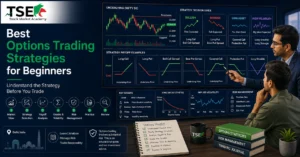
Options strategies range from simple single-option positions to combinations involving multiple options and, in some cases, the underlying asset.
For beginners, the objective should not be to find a strategy that guarantees profit. No options strategy can do that.
A better approach is to understand:
Market View → Strategy Structure → Maximum Risk → Potential Reward → Breakeven → Time → Volatility
This guide explains 10 options trading strategies for beginners, including long calls, long puts, covered calls, protective puts, spreads, straddles and strangles.
For each strategy, we will look at its basic structure, market outlook, major risks and the conditions beginners should understand before considering it.
Educational Disclaimer: This article is for educational and informational purposes only. It does not constitute investment, financial or trading advice or a recommendation to buy or sell securities or derivatives. Options trading involves substantial risk and can result in significant losses. Examples are simplified and hypothetical.
Quick Answer: Which Options Strategies Should Beginners Learn?
Beginners can start by studying simpler strategies such as long calls and long puts before progressing to covered calls, protective puts and defined-risk spreads.
Once those structures are understood, strategies such as straddles and strangles can help explain how options can be used when the trader expects a large move but is uncertain about direction.
A useful progression is:
Long Call → Long Put → Covered Call → Protective Put → Bull Call Spread → Bear Put Spread → Bull Put Spread → Bear Call Spread → Long Straddle → Long Strangle
This is a learning sequence, not a recommendation to trade each strategy.
Options Trading Strategies Comparison
| Strategy | Market View | Basic Structure | Main Risk Characteristic | Level |
|---|---|---|---|---|
| Long Call | Bullish | Buy Call | Premium paid at risk* | Beginner |
| Long Put | Bearish | Buy Put | Premium paid at risk* | Beginner |
| Covered Call | Neutral to moderately bullish | Own underlying + sell Call | Underlying downside remains | Intermediate |
| Protective Put | Bullish + downside protection | Own underlying + buy Put | Protection has a premium cost | Intermediate |
| Bull Call Spread | Moderately bullish | Buy Call + sell higher Call | Defined risk, capped reward | Beginner–Intermediate |
| Bear Put Spread | Moderately bearish | Buy Put + sell lower Put | Defined risk, capped reward | Beginner–Intermediate |
| Bull Put Spread | Neutral to moderately bullish | Sell Put + buy lower Put | Defined but meaningful downside risk | Intermediate |
| Bear Call Spread | Neutral to moderately bearish | Sell Call + buy higher Call | Defined but meaningful upside risk | Intermediate |
| Long Straddle | Large move expected | Buy Call + Put | Combined premiums at risk | Intermediate |
| Long Strangle | Large move expected | Buy OTM Call + OTM Put | Combined premiums at risk | Intermediate |
*For a standard standalone long vanilla option, loss is generally limited to the premium paid plus applicable costs, assuming no other positions alter the exposure.
This table is educational and does not indicate which strategy a particular trader should use.
What Is an Options Trading Strategy?
An options trading strategy is a predefined combination of one or more options and, in some cases, the underlying asset.
Different strategies can be constructed around different market expectations.
For example:
- Bullish movement
- Bearish movement
- Limited movement
- A large move in either direction
- Changes in volatility
- Hedging an existing position
- Premium collection
The important principle is:
The strategy should match the market view and an acceptable risk profile.
Choosing a strategy simply because its potential profit looks attractive ignores the most important part of the decision: what can happen when the market does not behave as expected?
What Should Beginners Know Before Learning Options Strategies?
Before comparing strategies, understand:
- Call options
- Put options
- Strike price
- Option premium
- Expiration
- ITM, ATM and OTM
- Intrinsic value
- Time value
- Time decay
- Implied volatility
- Options Greeks
- Option chain
- Liquidity
- Position sizing
- Maximum loss
If these concepts are still new, start with our Options Trading for Beginners guide.
You can then return to this page to compare strategies.
1. Long Call Strategy
A long call is one of the simplest bullish options strategies.
Structure
Buy 1 Call
Market Outlook
Bullish
The trader expects the underlying to rise sufficiently within the relevant timeframe.
Maximum Risk
For a standard standalone long call, the maximum loss is generally the premium paid plus applicable transaction costs.
Potential Reward
A long call can gain value as the underlying rises sufficiently, although actual results before expiration also depend on factors such as time and implied volatility.
Long Call Example
Suppose a hypothetical stock is trading at:
₹1,000
A trader buys:
₹1,050 Call
Premium:
₹30 per unit
At expiration, the simplified breakeven before applicable costs is:
₹1,050 + ₹30 = ₹1,080
Consider three hypothetical expiration prices.
| Underlying at Expiration | Intrinsic Value | Simplified Result per Unit* |
|---|---|---|
| ₹1,040 | ₹0 | -₹30 |
| ₹1,080 | ₹30 | ₹0 |
| ₹1,120 | ₹70 | +₹40 |
*Before applicable transaction costs.
What Can Hurt a Long Call?
- Underlying fails to rise sufficiently
- Expected movement occurs too late
- Time decay
- Unfavourable IV changes
- Paying excessive premium
Beginner Takeaway
A bullish view alone is not enough.
You also need to consider:
How far? How quickly? At what premium?
2. Long Put Strategy
A long put is a basic bearish options strategy.
Structure
Buy 1 Put
Market Outlook
Bearish
The trader expects the underlying to decline.
Maximum Risk
For a standard standalone long put, maximum loss is generally limited to the premium paid plus applicable costs.
Long Put Example
Suppose a hypothetical stock trades at:
₹1,000
A trader buys:
₹950 Put
Premium:
₹25 per unit
Simplified breakeven at expiration:
₹950 − ₹25 = ₹925
| Underlying at Expiration | Put Intrinsic Value | Simplified Result per Unit* |
|---|---|---|
| ₹970 | ₹0 | -₹25 |
| ₹925 | ₹25 | ₹0 |
| ₹880 | ₹70 | +₹45 |
*Before applicable transaction costs.
What Can Hurt a Long Put?
- Underlying does not decline sufficiently
- Market rises instead
- Time decay
- IV changes
- Expected decline occurs too late
Beginner Takeaway
Like a long call, a long put requires more than directional accuracy.
The magnitude and timing of the move matter.
3. Covered Call Strategy
A covered call combines ownership of an underlying asset with selling a call against that position.
Structure
Own Underlying + Sell Call
Market Outlook
Neutral to moderately bullish
The trader generally expects limited upside or is willing to sell the underlying at the call strike according to the contract structure.
Potential Benefit
The trader receives option premium from the short call.
Main Risk
The underlying can decline significantly.
The premium received provides only limited offset against that downside.
Covered Call Example
Suppose a hypothetical investor owns a stock at:
₹1,000
and sells:
₹1,100 Call for ₹20
If the stock remains below ₹1,100 at expiration, the call may expire without intrinsic value, subject to the contract and position circumstances.
If the stock rises significantly above ₹1,100, the short call limits the upside participation of the combined position according to the strategy’s payoff.
If the stock falls substantially, the ₹20 premium does not eliminate the loss on the underlying.
Beginner Takeaway
A covered call is not a risk-free income strategy.
The underlying’s downside risk remains important.
4. Protective Put Strategy
A protective put combines ownership of the underlying with buying a put.
Structure
Own Underlying + Buy Put
Market Outlook
Bullish on the underlying while seeking downside protection
Potential Benefit
The purchased put can limit part of the downside exposure according to the strategy’s structure.
Cost
Protection is not free.
The trader pays a premium for the put.
Protective Put Example
Suppose an investor owns a hypothetical stock at:
₹1,000
and buys:
₹900 Put for ₹20
If the stock rises, the investor can participate in the underlying’s upside, although the ₹20 put premium reduces the overall return.
If the stock declines significantly, the put can provide downside protection below its strike according to the payoff structure.
Beginner Takeaway
Think of the put premium as the cost of protection.
The strategy reduces certain downside exposure but also reduces the net return by the premium paid.
5. Bull Call Spread
A bull call spread is a defined-risk bullish strategy using two calls with different strikes.
Structure
Buy Lower-Strike Call + Sell Higher-Strike Call
The options generally have the same expiration.
Market Outlook
Moderately bullish
Maximum Risk
Generally limited to the net debit paid for the spread plus applicable costs.
Maximum Reward
Capped because the higher-strike call is sold.
Bull Call Spread Example
Suppose a hypothetical stock trades around ₹1,000.
A trader:
Buys ₹1,000 Call for ₹60
and:
Sells ₹1,100 Call for ₹20
Net debit:
₹60 − ₹20 = ₹40
Strike difference:
₹1,100 − ₹1,000 = ₹100
Simplified maximum loss:
₹40 per unit
Simplified maximum profit:
₹100 − ₹40 = ₹60 per unit
Simplified breakeven at expiration:
₹1,000 + ₹40 = ₹1,040
All figures exclude applicable transaction costs.
Beginner Takeaway
Compared with buying the ₹1,000 call alone, selling the higher-strike call reduces the initial net premium but also caps the maximum potential reward.
That trade-off is the heart of the strategy.
6. Bear Put Spread
A bear put spread is a defined-risk bearish strategy.
Structure
Buy Higher-Strike Put + Sell Lower-Strike Put
The options generally share the same expiration.
Market Outlook
Moderately bearish
Maximum Risk
Generally limited to the net debit paid plus applicable costs.
Maximum Reward
Capped.
Bear Put Spread Example
Suppose a hypothetical underlying trades around ₹1,000.
A trader:
Buys ₹1,000 Put for ₹55
and:
Sells ₹900 Put for ₹20
Net debit:
₹55 − ₹20 = ₹35
Strike difference:
₹100
Simplified maximum loss:
₹35 per unit
Simplified maximum profit:
₹100 − ₹35 = ₹65 per unit
Simplified breakeven at expiration:
₹1,000 − ₹35 = ₹965
Beginner Takeaway
A bear put spread can reduce the net premium compared with purchasing the higher-strike put alone, but the lower-strike short put caps the potential reward.
7. Bull Put Spread
A bull put spread is a credit spread with a neutral-to-bullish outlook.
Structure
Sell Higher-Strike Put + Buy Lower-Strike Put
The options generally have the same expiration.
Market Outlook
Neutral to moderately bullish
The trader generally wants the underlying to remain above the short-put strike at expiration.
Risk Characteristic
The lower-strike long put limits the downside of the short put, creating a defined-risk spread under the standard structure.
Bull Put Spread Example
Suppose a trader:
Sells ₹1,000 Put for ₹50
and:
Buys ₹900 Put for ₹20
Net credit:
₹50 − ₹20 = ₹30
Strike difference:
₹100
Simplified maximum profit:
₹30 per unit
Simplified maximum loss:
₹100 − ₹30 = ₹70 per unit
Simplified breakeven at expiration:
₹1,000 − ₹30 = ₹970
Figures exclude applicable costs.
Beginner Takeaway
Receiving a premium does not mean receiving risk-free income.
The maximum possible loss can be larger than the initial credit received.
8. Bear Call Spread
A bear call spread is a credit spread with a neutral-to-bearish outlook.
Structure
Sell Lower-Strike Call + Buy Higher-Strike Call
Market Outlook
Neutral to moderately bearish
The trader generally wants the underlying to remain below the short-call strike.
Risk Characteristic
The higher-strike long call limits the upside risk of the short call under the standard spread structure.
Bear Call Spread Example
Suppose a trader:
Sells ₹1,000 Call for ₹50
and:
Buys ₹1,100 Call for ₹20
Net credit:
₹30
Strike difference:
₹100
Simplified maximum profit:
₹30 per unit
Simplified maximum loss:
₹100 − ₹30 = ₹70 per unit
Simplified breakeven at expiration:
₹1,000 + ₹30 = ₹1,030
Beginner Takeaway
Again:
Premium received ≠ guaranteed profit.
The strategy can lose if the underlying moves sufficiently above the short-call strike.
9. Long Straddle
A long straddle combines a call and put, typically with the same strike and expiration.
Structure
Buy Call + Buy Put
Market Outlook
Expecting a large move but uncertain about direction
Maximum Risk
Generally limited to the combined premiums paid plus applicable costs.
Potential Reward
The strategy can benefit from a sufficiently large movement in either direction.
Long Straddle Example
Suppose a hypothetical underlying trades around:
₹1,000
A trader buys:
₹1,000 Call for ₹40
and:
₹1,000 Put for ₹35
Total premium:
₹75
Simplified upper breakeven at expiration:
₹1,000 + ₹75 = ₹1,075
Simplified lower breakeven:
₹1,000 − ₹75 = ₹925
If the underlying remains close to ₹1,000 at expiration, both options can lose substantial or all intrinsic/time value relevant to the position, with the combined premium at risk.
What Can Hurt the Strategy?
- Insufficient price movement
- Time decay
- Unfavourable IV changes
- Paying high combined premiums
Beginner Takeaway
A straddle isn’t simply:
“I don’t know the direction, so I’ll buy both.”
The underlying generally needs to move enough to overcome the combined premium and applicable costs.
10. Long Strangle
A long strangle is another strategy for traders expecting a substantial move but uncertain about direction.
Structure
Buy OTM Call + Buy OTM Put
The options generally share the same expiration.
Market Outlook
Large movement expected in either direction
Maximum Risk
Generally limited to the combined premiums paid plus applicable costs.
Long Strangle Example
Suppose an underlying trades at:
₹1,000
A trader buys:
₹1,050 Call for ₹20
and:
₹950 Put for ₹15
Combined premium:
₹35
Simplified upper breakeven at expiration:
₹1,050 + ₹35 = ₹1,085
Simplified lower breakeven:
₹950 − ₹35 = ₹915
Strangle vs Straddle
Because a long strangle generally uses OTM options, its initial premium may be lower than a comparable ATM straddle.
But the underlying generally needs a larger move to reach an expiration breakeven.
Beginner Takeaway
Lower initial premium does not automatically make a strangle “better.”
You are trading off:
Lower Cost ↔ Larger Required Movement
Which Options Strategy Is Best for Beginners?
There is no universally best options strategy for beginners.
Long calls and long puts are among the simplest structures to understand because each involves buying one option.
But:
Simple does not mean guaranteed profit or automatically low risk.
Once beginners understand calls, puts, premiums, expiration, time decay and IV, they can study defined-risk spreads such as bull call spreads and bear put spreads.
The appropriate strategy depends on:
- Market outlook
- Expected size of the move
- Timing
- Volatility
- Risk tolerance
- Capital
- Liquidity
- Position size
The goal isn’t to find the strategy with the most attractive payoff diagram.
It is to understand which risk/reward structure matches a clearly defined market view.
How to Choose an Options Trading Strategy
Instead of asking:
“Which options strategy makes the most money?”
use the following framework.
1. What Is Your Market View?
Are you:
Bullish?
Bearish?
Neutral?
Expecting a large move?
Direction is the first filter.
2. How Large a Move Do You Expect?
A mildly bullish view is different from expecting a major rally.
That distinction can affect which strategy structure you study.
3. When Do You Expect the Move?
Options expire.
A directional view can be correct but poorly timed.
4. What Is Implied Volatility?
Option premiums can be affected by IV.
You should understand the volatility exposure of the strategy rather than evaluating direction alone.
5. What Is the Maximum Loss?
Know the potential risk before entry.
Do not calculate it only after the position moves against you.
6. What Is the Potential Reward?
Some strategies have capped potential rewards.
Others have different payoff characteristics.
Understand the trade-off.
7. Where Is the Breakeven?
Breakeven helps you understand how much movement may be required by expiration under a simplified payoff analysis.
8. Is There Enough Liquidity?
Check factors such as:
- Bid-ask spread
- Volume
- Open interest
- Execution quality
A theoretically attractive strategy can be difficult to execute efficiently in illiquid contracts.
A useful framework is:
Market View → Expected Move → Time → IV → Risk → Reward → Breakeven → Liquidity
Debit vs Credit Options Strategies
Another way to classify strategies is by their initial cash flow.
Debit Strategy
You pay a net premium to establish the position.
Examples include:
- Long Call
- Long Put
- Bull Call Spread
- Bear Put Spread
- Long Straddle
- Long Strangle
Credit Strategy
You receive a net premium when establishing the position.
Examples in this article include:
- Bull Put Spread
- Bear Call Spread
A credit does not mean the strategy is safer.
Always compare:
Premium Received vs Maximum Possible Loss
Defined-Risk vs Undefined-Risk Strategies
A defined-risk strategy has a calculable maximum loss under its standard payoff structure.
Examples include:
- Long Call
- Long Put
- Bull Call Spread
- Bear Put Spread
- Bull Put Spread
- Bear Call Spread
- Long Straddle
- Long Strangle
This does not mean the loss is small.
A position can have defined risk and still be oversized relative to the trader’s capital.
Some uncovered short-option strategies can have substantially different and potentially very large risk characteristics. Beginners should understand those exposures before considering them.
How Greeks Affect Options Strategies
Options strategies should not be evaluated only through bullish or bearish labels.
| Greek | Strategy Question |
|---|---|
| Delta | How sensitive is the position to underlying-price movement? |
| Gamma | How can Delta change as the underlying moves? |
| Theta | How does passage of time affect the position? |
| Vega | How can IV changes affect the position? |
For example, a long call can benefit from favourable underlying movement but can also be affected by time decay and changes in IV.
A multi-leg strategy combines the exposures of its individual legs.
If you’re not yet comfortable with Greeks, first build the foundation in Options Trading for Beginners at /options-trading-for-beginners/.
How Implied Volatility Affects Strategy Selection
Implied volatility can materially affect option premiums.
All else equal:
Higher IV → Higher Option Premiums
Lower IV → Lower Option Premiums
But multi-leg strategies can have more complicated net volatility exposure because they contain both purchased and sold options.
This means:
Bullish or bearish direction alone is not a complete strategy-selection framework.
Volatility matters too.
Why Time Decay Matters
Options have expiration dates.
That makes time part of the strategy.
Consider two traders with the same bullish view.
One buys an option with more time remaining.
Another uses a much shorter-dated option.
Even if both are correct about direction, their outcomes can differ because:
- Time remaining differs
- Theta exposure differs
- Premiums differ
- IV may differ
- Required movement may differ
Expiration selection is therefore part of strategy construction.
Risk Management for Options Strategies
A strategy is incomplete without a risk-management framework.
Know Maximum Risk
Understand the potential loss before entering.
Size the Position
Do not determine position size simply from the margin or capital available.
A defined-risk spread can still cause an unnecessarily large account-level loss if oversized.
Define an Exit Framework
Determine what invalidates the original market thesis.
Consider Portfolio Exposure
Multiple positions may be exposed to the same underlying risk.
Several “different” trades can therefore behave like one large correlated position.
Account for Drawdowns
A strategy can experience consecutive losses.
Position sizing should reflect the possibility of losing periods.
Account for Costs
Actual results can be affected by:
- Brokerage
- Applicable exchange charges
- Taxes
- Regulatory charges
- Bid-ask spreads
- Slippage
Always evaluate net, not just theoretical, outcomes.
How Beginners Can Practise Options Strategies
Before considering substantial capital, practise strategy construction systematically.
Step 1: Choose an Underlying
Study a sufficiently liquid underlying.
Step 2: Define the Market View
Write down whether the view is:
Bullish / Bearish / Neutral / Large Move Expected
Step 3: Choose a Strategy
Select a structure that logically matches the view.
Step 4: Calculate the Payoff
Determine:
- Maximum risk
- Potential reward
- Breakeven
- Relevant strategy assumptions
Step 5: Record the Assumptions
Write down:
- Why the strategy was chosen
- Why those strikes were selected
- Why that expiration was selected
- What would invalidate the thesis
Step 6: Observe the Position
Track changes in:
- Underlying price
- Premium
- IV
- Time remaining
- Greeks
Step 7: Review
After the trade or simulation, ask:
Was the market analysis wrong?
Was the strategy poorly matched to the view?
Was the timing poor?
Was the position oversized?
Did IV behave differently than expected?
Did I follow the original plan?
This is more useful than simply recording whether the trade won or lost.
Options Strategies vs Trading Calls
Learning a strategy is different from following a trade call.
A call might tell you:
Buy this option.
Strategy education should help you answer:
- Why this strategy?
- Why this option?
- Why this strike?
- Why this expiration?
- What market condition is expected?
- What is the maximum risk?
- What is the breakeven?
- What invalidates the trade?
- How could time affect it?
- How could volatility affect it?
The objective of education should be to develop independent decision-making, not dependence on calls.
Common Options Strategy Mistakes
Choosing a Strategy Because the Profit Looks Attractive
Potential reward should never be evaluated without potential loss.
Ignoring Implied Volatility
IV can affect option premiums and strategy outcomes.
Ignoring Time Decay
Time can work differently across options positions.
Treating Premium Selling as Guaranteed Income
Receiving premium means accepting contractual exposure.
It is not guaranteed income.
Trading Too Many Strategies
Beginners often benefit more from understanding a small number of structures deeply than memorising dozens.
Ignoring Liquidity
Wide bid-ask spreads can increase execution costs.
Using Excessive Position Size
Defined risk does not mean insignificant risk.
Focusing Only on Win Rate
A high win rate does not automatically make a strategy profitable.
Copying Strategies Without Understanding Payoffs
If you cannot explain the maximum risk and breakeven, study the structure further before considering live execution.
Frequently Asked Questions
What Are the Best Options Trading Strategies for Beginners?
There is no universally best strategy. Beginners can start by studying simpler structures such as long calls and long puts, then progress to protective positions and defined-risk spreads after understanding premiums, expiration, volatility and risk.
Which Options Strategy Is Easiest to Understand?
Long calls and long puts are generally among the simplest because each involves purchasing one option.
Simple structure does not mean guaranteed profit.
What Is a Good Bullish Options Strategy for Beginners to Study?
A long call is one of the simplest bullish structures to understand. A bull call spread is another defined-risk bullish strategy worth studying once the beginner understands multi-leg positions.
Neither guarantees a profitable outcome.
What Is a Bearish Options Strategy?
Long puts and bear put spreads are examples of bearish strategies.
They have different premium, payoff and risk characteristics.
What Options Strategies Can Be Used for a Large Move?
Long straddles and long strangles are commonly studied when a large movement is expected but direction is uncertain.
Both can lose if the underlying fails to move sufficiently, and both are affected by time and volatility.
Is Options Selling Suitable for Beginners?
Options-selling strategies can involve substantial risk.
Beginners should understand maximum loss, margin, payoff structure, volatility exposure and position sizing before considering them.
What Is the Safest Options Strategy?
There is no universally “safe” options strategy.
Risk depends on the structure, position size, market conditions, liquidity and execution.
Can Options Strategies Guarantee Profit?
No.
No options strategy can guarantee profit.
What Is the Difference Between a Bull Call Spread and Bull Put Spread?
Both can express a bullish or moderately bullish view, but their construction differs.
A bull call spread is generally established for a net debit, while a bull put spread is generally established for a net credit.
Their payoff and risk characteristics should be evaluated separately.
What Is the Difference Between a Straddle and Strangle?
A long straddle generally buys a call and put with the same strike.
A long strangle generally buys an OTM call and OTM put with different strikes.
A strangle may cost less initially but generally requires a larger underlying move to reach its expiration breakevens.
Should Beginners Trade Weekly Options?
Short-dated options can be highly sensitive to time decay and underlying-price changes.
Beginners should understand those characteristics before trading short-dated contracts.
How Do I Choose an Options Strategy?
Start with:
Market View → Expected Move → Timing → IV → Maximum Risk → Potential Reward → Breakeven → Liquidity
Then compare structures that fit those conditions.
Can I Practise Options Strategies Without Real Money?
Paper trading, historical analysis and suitable simulation can help you practise strategy construction and risk management without immediately committing significant capital.
However, simulated results do not perfectly reproduce live-market execution, liquidity, slippage or emotional pressure.
What Should You Learn Next?
If calls, puts, premiums, option chains and Greeks are still new, start with Options Trading for Beginners
If you want to learn options in a structured sequence, continue to How to Learn Options Trading in India.
For the basic definition and mechanics of options, read What Is Options Trading?.
For chart reading, trends, support, resistance and market structure, read Technical Analysis for Beginners.
The cluster should work as:
Definition → Beginner Foundation → Learning Roadmap → Strategies → Structured Education
Looking for Structured Options Trading Education?
Some learners prefer guided instruction instead of studying individual strategies from disconnected sources.
When evaluating an options trading course, look for education covering:
- Options fundamentals
- Option-chain analysis
- Implied volatility
- Greeks
- Technical analysis
- Strategy construction
- Payoff analysis
- Position sizing
- Risk management
- Practical exercises
Avoid choosing a course because it promises:
- Guaranteed profits
- Guaranteed accuracy
- Fixed monthly income
- No-loss trading
- Guaranteed returns
You can review Trading Smart Edge’s Options Trading Course in Delhi at to compare its curriculum with your learning needs.
Education can improve understanding, but no course can guarantee trading profits.
Final Takeaway
The best options trading strategy for a beginner is not necessarily the strategy with the highest theoretical profit.
It is more useful to start with strategies you can clearly explain.
Begin with:
Long Call → Long Put
Then understand positions involving an underlying:
Covered Call → Protective Put
Progress to defined-risk spreads:
Bull Call Spread → Bear Put Spread → Bull Put Spread → Bear Call Spread
Then study volatility-oriented structures:
Long Straddle → Long Strangle
For every strategy, ask:
What is my market view?
How large a move do I expect?
When do I expect it?
What is the maximum risk?
What is the potential reward?
Where is the breakeven?
How can time affect the position?
How can implied volatility affect it?
What happens if I am wrong?
If you cannot answer those questions, learn the structure further before considering live execution.
The goal is not to memorise as many options strategies as possible.
The goal is to understand why a strategy fits a particular market view, how its payoff works and what risk you are accepting.
Educational Disclaimer: This article is for educational and informational purposes only. It does not constitute investment, financial, tax, research or trading advice or a recommendation to buy or sell any security or derivative. Options trading involves substantial risk and can result in significant losses. All numerical examples are simplified and hypothetical and exclude applicable transaction costs unless stated otherwise. Actual option values before expiration can differ because of factors including time, volatility, liquidity and market conditions. Verify current contract specifications, lot sizes, expiration schedules, margin requirements, transaction costs, taxation and applicable regulatory requirements with the relevant exchange, broker or regulatory authority before trading.