Quick Answer: Understanding what is insider trading is essential for maintaining a fair and transparent securities market. In simple terms, it involves trading a public company’s securities using confidential, unpublished price-sensitive information, giving those individuals an unfair advantage over everyday retail investors.
Introduction
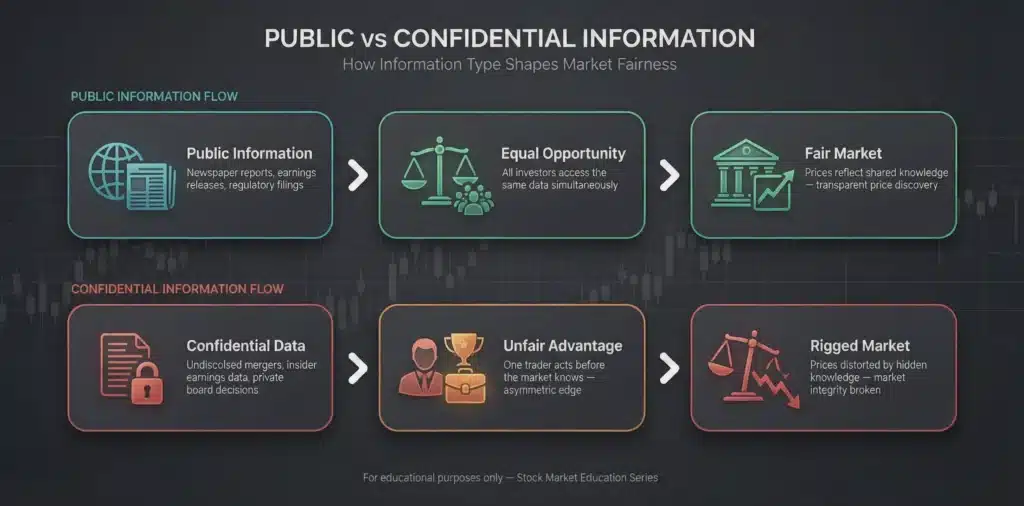
Every investor entering the stock market should understand what is insider trading and how regulatory bodies protect market integrity. Public equity markets thrive on fairness, transparency, and equal opportunity. When a select few manipulate confidential information for personal gain, it shatters investor confidence.
Regulated by the Securities and Exchange Board of India (SEBI), strict SEBI insider trading regulations are designed to ensure that the securities market remains a level playing field. Whether you are a beginner exploring stock market terms for beginners or a finance student preparing for NISM examinations, knowing the boundaries of legal and illegal trading practices protects you from severe financial and criminal liabilities.
What Is Insider Trading?
Definition and Meaning in Simple Language
Insider trading meaning refers to the buying or selling of a publicly traded company’s shares or other securities by individuals who possess material, non-public information about that company.
Featured Snippet Definition: Insider trading is the trading of a public company’s stock or other securities by individuals with access to non-public, material information about the company. While legal insider trading occurs when corporate insiders buy or trade shares through proper disclosures and open trading windows, illegal insider trading exploits confidential corporate data for personal financial gain at the expense of public investors.
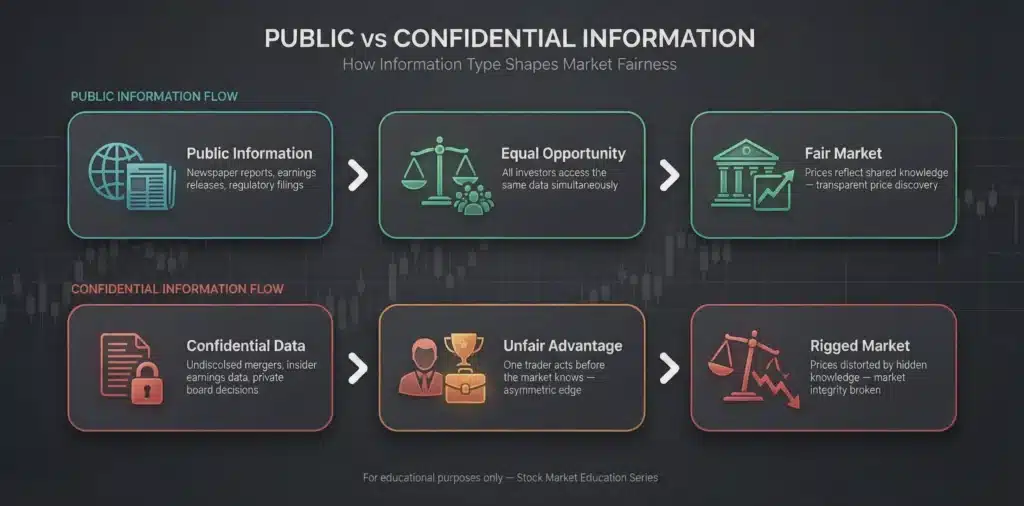
Why Is Insider Trading Illegal?
The prohibition of insider trading rests on several core pillars of corporate governance and market ethics:
- Equal Opportunity: Every participant in the securities market deserves equal access to material information.
- Market Transparency: Transparency builds trust, encouraging broader public participation.
- Investor Confidence: Retail investors will not risk their capital in a rigged environment.
- Fair Price Discovery: Prices must reflect open market supply and demand, not hidden inside knowledge.
What Is Unpublished Price Sensitive Information (UPSI)?
At the heart of insider trading regulations is Unpublished Price Sensitive Information (UPSI). This refers to any information relating to a company or its securities that is not generally public and, if made public, would materially affect the price of its securities.
Common Examples of UPSI
- Quarterly or annual financial results.
- Official dividend declarations.
- Bonus issue or stock split announcements.
- Corporate mergers, acquisitions, or demergers.
- Rights issues or large structural stake sales by promoters.
- Impending bankruptcy, insolvency, or severe financial distress.
- Securing or losing massive commercial orders.
Note: Not all confidential corporate information qualifies as UPSI; it must be material enough to influence market prices upon public disclosure.
Who Is Considered an Insider?
Under SEBI guidelines, the definition of an “insider” extends far beyond top-tier executives:
Connected Persons
- Chief Executive Officers (CEOs), Managing Directors, and Board Directors.
- Chief Financial Officers (CFOs) and key managerial personnel.
- Regular corporate employees handling sensitive data.
Immediate Relatives
- Spouses, parents, siblings, and children who are financially dependent or consult with the primary insider.
Professional Advisors
- Chartered Accountants, Company Secretaries, statutory auditors, legal counsels, and merchant bankers.
Tippees
- Any individual or third party who receives and acts upon confidential tips passed down from connected persons.
Types of Insider Trading
Illegal Insider Trading
Executing buy or sell orders in a listed company while consciously possessing material UPSI.
Insider Tipping
Passing on confidential price-sensitive data to friends, family members, or third parties who subsequently trade on that information.
Front Running
A specialized form of market abuse where brokers or intermediaries trade ahead of large client orders to pocket risk-free profits.
Legal Insider Trading
Corporate executives and designated persons buying or selling shares of their own company legally, provided they do so during an open trading window, without possessing UPSI, and after making mandatory SEBI disclosures.
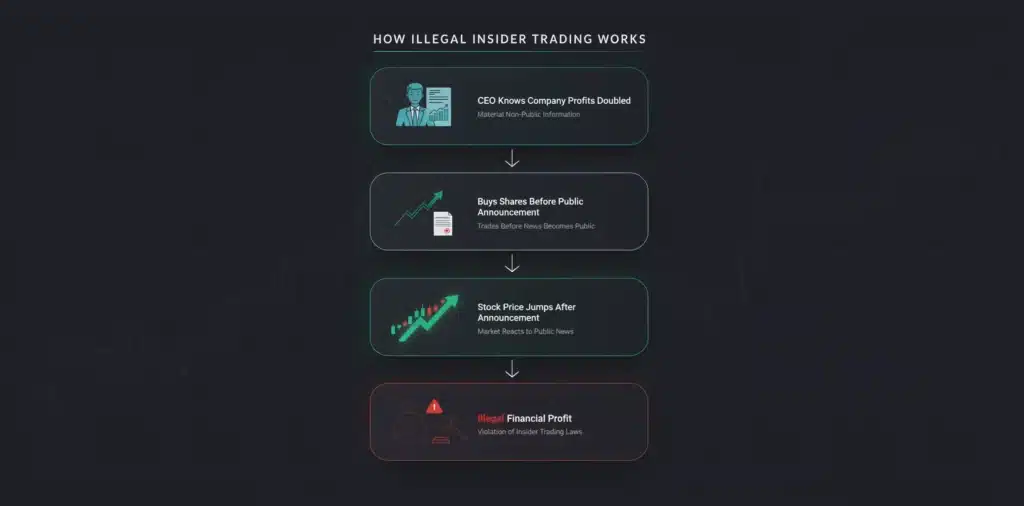
How Does Insider Trading Work?
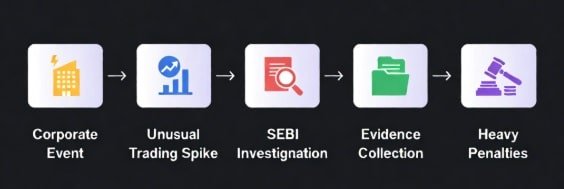
The mechanics of illegal trading typically follow a predictable lifecycle of abuse:
Real Insider Trading Cases
Disclaimer: The following historical cases are presented strictly for educational and illustrative purposes.
| Case | What Happened | Action Taken by Regulators |
| Hindustan Lever Ltd. (HLL) | Traded shares of Brook Bond India prior to a merger announcement using advance knowledge of the amalgamation. | SEBI imposed penalties and directed corrective financial restitution. |
| Acclaim Industries | Managing Director sold substantial personal holdings right before negative financial results were declared. | Imposed heavy monetary fines and regulatory restrictions. |
| Rajat Gupta Case | Shared confidential boardroom tips regarding Goldman Sachs with hedge fund managers. | Led to federal criminal conviction and imprisonment in the United States. |
How Does SEBI Detect Insider Trading?
Regulatory authorities employ advanced surveillance and investigative tools:
- Sophisticated surveillance systems and algorithmic pattern monitoring.
- Automated trade matching engines to flag pre-announcement volume spikes.
- Comprehensive email, phone records, and electronic communication investigations.
- Demat account tracking and cross-referencing family tree databases.
- Cross-border coordination with global financial regulators.
Penalties for Insider Trading in India
Violating insider trading laws carries severe statutory consequences under the SEBI Act:
| Violation Severity | Statutory Consequence |
| Financial Penalty | Heavy monetary fines ranging from ₹25 lakhs up to ₹25 crores, or three times the profit made. |
| Disgorgement | Mandatory surrender of all illegal profits back to the regulatory authorities. |
| Trading Ban | Complete debarment from accessing securities markets or holding directorial positions. |
| Criminal Proceedings | Prosecution under Section 24 of the SEBI Act. |
| Imprisonment | Rigorous imprisonment of up to 10 years for severe criminal infractions. |
Insider Trading vs Market Manipulation
| Feature | Insider Trading | Market Manipulation |
| Core Mechanism | Uses confidential, non-public information (UPSI). | Artificially inflates or deflates prices via coordinated trading (e.g., pump-and-dump). |
| Advantage Type | Information asymmetry advantage. | Artificial supply and demand distortion. |
| Legal Status | Strictly illegal. | Strictly illegal. |
Can Company Employees Legally Buy Company Shares?
Yes, absolutely. Company employees, executives, and promoters are legally permitted to buy shares of their own company under strict compliance frameworks:
- The company’s designated trading window must be officially open.
- The employee must possess zero UPSI.
- Prior approval must be obtained from the company’s Compliance Officer.
- Mandatory disclosures must be submitted to the stock exchanges within prescribed timelines.
Why Insider Trading Harms Retail Investors
- Loss of Trust: Destroys faith in the fairness of public exchanges.
- Unfair Wealth Transfer: Transfers wealth from unsuspecting retail buyers to privileged insiders.
- Reduced Market Participation: Discourages long-term retail investments.
- Lower Liquidity: Degrades overall market health and corporate governance standards.
Common Myths About Insider Trading
- Myth: Only CEOs and board directors get penalized.
- Fact: Anyone possessing UPSI—including junior assistants, accountants, or external auditors—can be held legally liable.
- Myth: Sharing a casual tip with a friend is not illegal.
- Fact: “Tipping” is explicitly prohibited under SEBI regulations.
- Myth: Small trade sizes cannot be detected by regulators.
- Fact: Modern AI-driven surveillance flags anomalous trading patterns regardless of capital size.
How to Stay Safe as an Investor
Protect your capital and maintain ethical standards by avoiding high-risk shortcuts:
- Avoid unverified Telegram tips, WhatsApp stock groups, and guaranteed insider news.
- Never touch illegal pump-and-dump schemes.
- Focus on fundamental and technical research. For guidance, explore our tutorials on how to analyze balance sheets to pick stocks and how to pick winning stocks like Warren Buffett.
- Strict adherence to SEBI guidelines and portfolio diversification. Read our guide on what is portfolio diversification and why is it important?.
Frequently Asked Questions
Q1. What is insider trading?
Ans: Insider trading involves buying or selling securities of a publicly traded company while in possession of material, non-public information (UPSI).
Q2. What is insider trading in India?
Ans: In India, insider trading is strictly regulated and penalized by SEBI under the SEBI (Prohibition of Insider Trading) Regulations.
Q3. Why is insider trading illegal?
Ans: It creates an unfair playing field, breaches fiduciary duty, destroys investor confidence, and violates the core principle of equal market access.
Q4. What is UPSI in the stock market?
Ans: UPSI stands for Unpublished Price Sensitive Information, which includes confidential financial results, mergers, or major corporate announcements not yet made public.
Q5. Who is considered an insider under SEBI regulations?
Ans: Insiders include connected persons (directors, officers, employees), immediate relatives, professional advisors, and anyone possessing access to UPSI.
Q6. Can employees legally buy shares of their own company?
Ans: Yes, employees can legally buy company shares when the trading window is open, they possess no UPSI, and they follow company compliance procedures.
Q7. What are the penalties for insider trading in India?
Ans: Penalties include hefty monetary fines, disgorgement of illegal profits, debarment from capital markets, and potential imprisonment.
Q8. How does SEBI detect insider trading?
Ans: SEBI uses advanced surveillance systems, algorithmic trade monitoring, communication audits, and demat pattern matching to uncover illegal trades.
Q9. What is the difference between legal and illegal insider trading?
Ans: Legal insider trading follows strict disclosure rules and open trading windows without UPSI, whereas illegal trading exploits confidential insider data.
Q10. What is the difference between insider trading and market manipulation?
Ans: Insider trading relies on confidential information advantages, while market manipulation uses artificial trading tactics to distort prices.
Q11. Is insider trading a criminal offence in India?
Ans: Yes, severe insider trading violations can trigger criminal prosecution and imprisonment under the SEBI Act.
Q12. How can investors avoid insider trading violations?
Ans: Investors can stay safe by ignoring insider tips, steering clear of unverified social media groups, and investing based on transparent public research.
Final Thoughts
Insider trading destroys trust, undermines market integrity, and harms everyday participants. Fair markets protect all investors by ensuring that stock prices reflect true economic value rather than privileged secrets. Build your wealth through structured knowledge, rigorous research, and disciplined investing—never through shortcuts.
Want to understand stock market regulations, technical analysis, and professional investing? Join Trading Smart Edge‘s Stock Market Course in Delhi and learn from experienced market professionals. Contact us today to begin your journey!