You are sitting in front of your trading terminal at 9:28 AM on a volatile Thursday morning. Bank Nifty has just gapped down by 1.5% following an unexpected macroeconomic announcement from the West. Your screen is a sea of blinking red data rows. Your pulse accelerates. Every retail instinct in your body is screaming at you to immediately hit the market sell button to cut your losses. Simultaneously, a wave of pure greed tells you to double your position size, averaging down in the desperate hope of a sudden morning pullback.
You are frozen in a state of pure cognitive paralysis. While you sit there agonizing over a 5-minute candlestick chart, a cold, unfeeling server farm operating out of a technology park in Bengaluru has already processed that exact data gap in 12 milliseconds. It mathematically audited the volume profile, calculated the precise variance from the Volume Weighted Average Price (VWAP), executed a multi-leg options hedge across the exchange matching books, and closed the position with a razor-sharp net profit.
That is the unvarnished reality of the modern financial system. The financial markets are no longer a battleground of human intuition or gut feel. They are a continuous, high-velocity network of computing power, automated order routing, and systematic probability. Staring at an app dashboard attempting to manually out-think these enterprise server arrays is an exercise in absolute futility. If you want to survive the next decade of market evolution, you have to upgrade your execution plumbing. You must transition to a systematic framework.
Welcome to the ultimate launchpad for algo trading india infrastructure. This exhaustive guide will dismantle the complex jargon surrounding quantitative automation. We will look past the marketing hype of fintech platforms, translate how broker APIs actually speak to matching engines, and give you a step-by-step operational blueprint to build a rule-based execution matrix that strips destructive human emotion completely out of your financial equation.
The Quick Answer
| The Core Mechanism: Success in algo trading india structures means translating a mathematically backtested strategy with a proven statistical edge into a series of automated code blocks or logical parameters that execute trades without human intervention. The Technological Plumbing: Automation requires connecting a strategy engine (like Tradetron or a custom Python script) to your stockbroker’s execution ledger via a secure Application Programming Interface (API), firing orders in milliseconds. The Strategic Discipline: Automation does not magically turn a losing strategy into a winning one. True portfolio longevity demands absolute adherence to rigid mathematical risk rules, constant execution logging, and continuous performance tracking. |
Table of Contents
1. Stripping Away the Sci-Fi Myth: What Automated Execution Actually Means
Before we analyze the code bases, cloud servers, and data pipelines, we must dismantle a dangerous psychological misconception that routinely traps retail beginners. Algorithmic trading is not a magical, sentient artificial intelligence. It is not an automated money printing press that searches the internet for secret patterns while you sleep on a beach.
An algorithm is simply a series of rigid, unyielding logical parameters wrapped inside software code. It is an electronic checklist that reads:
IF Condition A and Condition B are Met THEN Execute Action C
Imagine you possess a highly disciplined momentum strategy. Your rule mandates that if the 9-period Exponential Moving Average (EMA) crosses above the 21-period EMA on a 15-minute chart of HDFC Bank on heavy volume, you buy exactly 500 shares. Your rule also dictates that the moment the trade goes live, you automatically place a target bracket 2% above entry and a protective stop-loss 1% below entry.
If you attempt to execute this strategy manually, human biology will sabotage you. You will check your phone late, hesitate because you are afraid of a sudden market reversal, or manually cancel your stop-loss order out of blind hope when the price drops.
An algorithmic architecture takes that exact trading plan, maps it onto an automation engine, and binds it to the exchange ledger. The system checks the data feed every millisecond. The exact moment the moving averages cross, the order is generated, validated against your capital limits, and routed to the matching engines before your human brain can even process the shape of the candlestick. The machine does not hope, it does not fear, and it never improvises. It simply executes the math.
To fully appreciate why this systematic transition is so critical, establishing a rigorous structural foundation is paramount. Beginners must first grasp how price behavior naturally operates on charts before attempting to automate those movements; checking a comprehensive, ground-up guide to technical analysis in India offers an invaluable starting map.
2. The Legal Matrix: Understanding SEBI’s Automated Guidelines
The regulatory landscape governing automated trading inside the Indian financial ecosystem is exceptionally unique, and it is entirely designed to protect retail participants from systemic flash crashes. The Securities and Exchange Board of India (SEBI) maintains a highly sophisticated, multi-tiered framework that strictly categorizes automated participants based on their capital scale and network routing locations.
Institutional Algorithmic Architectures (Colocation)
Massive high-frequency trading (HFT) firms, hedge funds, and foreign institutional investors do not place trades through smartphone applications. They rent server racks located physically inside the exchange building in Mumbai. This is known as colocation.
By placing their private execution servers inches away from the exchange’s central matching engines, they eliminate the latency of fiber-optic transit across the country. They measure their transaction speeds in microseconds. SEBI subjects these institutional automated programs to intense regulatory stress tests, algorithmic auditing, and massive compliance deposits to ensure their code cannot trigger a market loop failure.
The Retail Automated Gateway (API Broking)
For independent retail investors and tech-savvy quantitative analysts, SEBI has facilitated a highly efficient, regulated pathway via approved retail broker APIs. Under current guidelines, a retail participant cannot write a rogue automated program that pings the exchange matching books directly. Instead, your code must route its commands directly into your stockbroker’s risk management system first.
Your broker acts as the ultimate regulatory firewall. When your code fires a buy order, the broker’s system checks your margins in microseconds, verifies that the target stock is not trapped inside a lower circuit breaker band, and ensures compliance with upfront peak margin obligations. This structure allows retail traders to harness the power of automation safely, knowing that the structural plumbing is entirely policed by government-approved firewalls.
3. The Digital Pipelines: How Broker APIs Actually Operate
You understand the regulatory boundaries. Now, how does a raw mathematical idea floating in your brain physically convert into an automated fill on the exchange ledger? You require an Application Programming Interface (API).
An API is simply a digital translation bridge that allows two completely separate software programs to securely talk to each other and swap data packets in real time. In the context of algo trading india structures, you have an analytical frontend (where your strategy logic lives) that needs to talk continuously to your broker’s backend ledger.
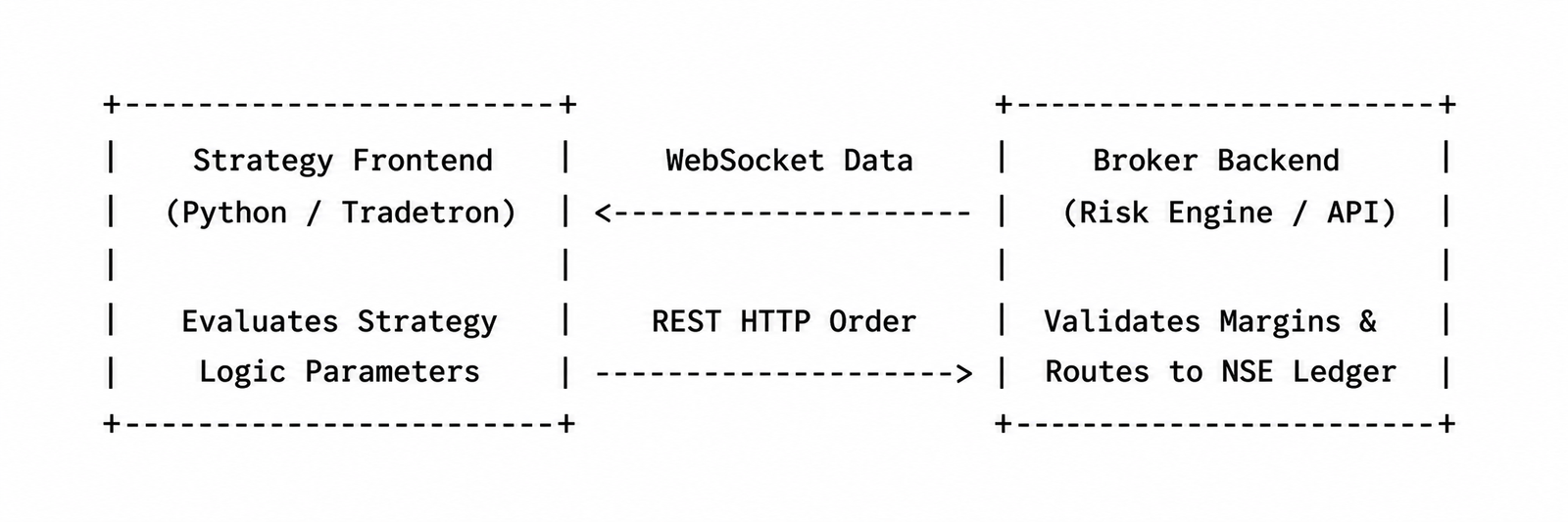
When you activate an API gateway through discount broking titans like Zerodha (Kite Connect), Angel One (SmartAPI), or Upstox, your automated pipeline relies on two primary digital channels:
1. The WebSocket Streaming Feed (The Input Pipeline)
To make logical trading decisions, your strategy engine needs to know the exact price of an asset every millisecond. WebSocket is a continuous, open digital highway that streams raw market data—the Last Traded Price (LTP), bid-ask spreads, and current candle volumes—directly from the exchange into your strategy script. It is the sensory organ of your algorithm.
2. The REST API Endpoint (The Output Pipeline)
When your strategy script processes the incoming WebSocket data and determines that all your buying parameters are perfectly satisfied, it generates a structured HTTP POST request. This text block contains explicit transactional metadata
| JSON { “variety”: “REGULAR”, “exchange”: “NSE”, “tradingsymbol”: “RELIANCE”, “transaction_type”: “BUY”, “order_type”: “LIMIT”, “quantity”: 100, “price”: 2450.00, “product”: “MIS” } |
The script fires this precise JSON packet to the broker’s secure API endpoint. The broker’s automated risk gateway reads the packet, verifies that your trading ledger holds sufficient margin, and instantaneously routes the order directly to the exchange matching book. This entire round-trip processing sequence executes seamlessly in milliseconds, entirely bypassing human intervention.
4. Coding vs. No-Code Algo Trading: Choosing Your Toolkit
A deep cognitive chasm exists within the automated trading space. Beginners routinely assume that if they do not possess a Master’s degree in Computer Science or fluency in advanced C++, they are completely locked out of automation. This assumption is entirely false. Modern financial technology has completely democratized the landscape, splitting the ecosystem into two highly functional environments.
The No-Code Automation Ecosystem (The Logic Blocks)
For retail participants who want to focus entirely on strategy design rather than debugging syntax errors, no-code automated deployment platforms have experienced an incredible evolution. Titans like Tradetron and Streak allow you to build complete automated pipelines using a purely visual, logic-block interface.
You do not write lines of code. Instead, you select natural language parameters from drop-down menus:
Select [Close] Crosses Above [Highest High] of last [20 Candles] on [15 Min Chart]
The platform automatically compiles your visual logic blocks into machine-readable code on their cloud servers.
They handle the live WebSocket data streams, manage the API connections to major Indian stockbrokers, and host your strategy on secure cloud infrastructure. This allows absolute beginners to step into automated trading with minimal technical friction.
The Custom Code Ecosystem (The Quant’s Edge)
For quantitative analysts, data scientists, and advanced programmers, no-code platforms can feel like a restrictive straightjacket. True technical freedom requires building custom automated pipelines from scratch using Python.
Python is the absolute undisputed global standard for modern quantitative research. By leveraging specialized open-source data libraries, programmers can build bespoke execution frameworks:
| Pandas & NumPy: For blindingly fast mathematical analysis of massive historical price arrays. Backtrader & TA-Lib: Specialized calculation engines used to simulate strategy performance across decades of historical market ticks. Bespoke API Packages: Dedicated wrappers developed directly by brokers to natively bind Python scripts to their transaction routing engines. |
Custom coding grants you absolute architectural freedom. You can design intricate non-linear profit trailing brackets, integrate alternative data streams (like options open interest changes or real-time news sentiment analytics), and build proprietary portfolio rebalancing models that no-code platforms cannot mathematically support. However, it demands a high tier of technical accountability. A missing comma or an unhandled exception loop inside your Python script can cause your live algorithm to repeatedly fire erroneous orders into the market, devastating your trading capital in a flash.
5. Curated Platform Reviews: Evaluating the Heavyweights
If you choose to bypass custom Python script development and opt for an established retail automated platform, you must evaluate the market infrastructure carefully. Let’s provide an unbiased breakdown of the dominant execution systems controlling retail automated liquidity today.
Tradetron — The Options Strategy Heavyweight
Tradetron is arguably the most powerful and widely deployed multi-broker automation platform operating in the Indian market today. It is built explicitly to handle the complex, multi-leg options execution logic that dominates NSE weekly expiries.
| The Core Architecture: Tradetron operates as a cloud-based strategy marketplace and creation engine. It uses an intricate, keyword-driven wizard interface that allows you to construct highly advanced multi-leg derivative strategies (like Iron Condors, Straddles, or custom calendar spreads) with total parameter control. The Standout Feature: Flawless multi-broker cross-execution. You can write a single proprietary strategy block on Tradetron and digitally deploy it to execute simultaneously across completely separate broker accounts (e.g., Zerodha, Angel One, and 5paisa) using a centralized command dashboard. It also features a highly robust paper trading engine that simulates live market data and exchange slippages with high fidelity. The Practical Limitation: The user interface carries a distinctly steep learning curve. The layout feels highly text-dense and industrial, resembling database entry tracking software rather than a sleek modern application. Beginners will require notable study time to accurately understand how to configure continuous loop variables without creating dangerous execution logic errors. |
Streak — The Visual Momentum Champion
Streak took an entirely different product path, designing an ultra-sleek, visual, and high-velocity automated workspace optimized for retail traders who focus primarily on linear equity cash and directional futures setups.
| The Core Architecture: Streak provides an exceptionally fast, intuitive platform tailored for rapid strategy generation, backtesting, and automated deployment. Its visual interface is beautifully optimized for mobile devices, making the act of auditing your strategies feel remarkably fluid. The Standout Feature: Blazing-fast backtesting performance. Streak has optimized its historical pricing database to an extraordinary degree. You can select a complex combination of technical indicators (such as MACD, Bollinger Bands, and Ichimoku Clouds), apply it across a 50-stock watchlist, and run a comprehensive 5-year historical backtest across multi-timeframe candles in under three seconds. It provides clean, scannable visual summaries of your win rates, maximum peak-to-trough drawdowns, and consecutive losing streaks. The Practical Limitation: Restrictive derivative logic. While Streak is spectacular for linear, directional strategies (buying a stock when it breaks out), it cannot natively support the intricate, non-linear multi-leg options Greeks adjustments that advanced derivatives writers require to manage complex gamma or theta portfolios. |
6. The Capital Defense Protocols: Risk Automation Is the True Edge
The single greatest trap in the entire automated trading arena is the illusion of the tool. Novice retail traders routinely assume that once they automate a strategy, they have achieved structural immunity from market losses. They believe that because a machine is placing the orders, the returns are guaranteed.
This assumption is a catastrophic behavioral failure. An algorithm does not magically turn a losing, expectancy-negative trading strategy into a winning one.
In fact, automation is a profound accelerator. If you hook an undisciplined, mathematically flawed trading idea to a high-speed broker API gateway, the machine will simply liquidate your total account capital at a velocity that will leave you completely breathless. Automation merely scales your execution consistency; it cannot manufacture an edge where none exists.
True quantitative longevity demands that you wrap your automation blocks inside an ironclad, mechanical risk preservation system. To survive this environment, you must build capital defense protocols directly into your script logic.
Automated Capital Allocation Modeling
Your script must never determine position sizing based on a feeling or an arbitrary rounded number. The algorithm must calculate position sizes dynamically before firing an order packet, using a defined mathematical framework tied directly to your real-time ledger balance.
The undisputed industry benchmark for capital preservation is the 2% maximum risk rule. This absolute boundary dictates that under no circumstances will a single tactical idea allow its stop-loss trigger to jeopardize more than 1% to 2% of your total account capital.
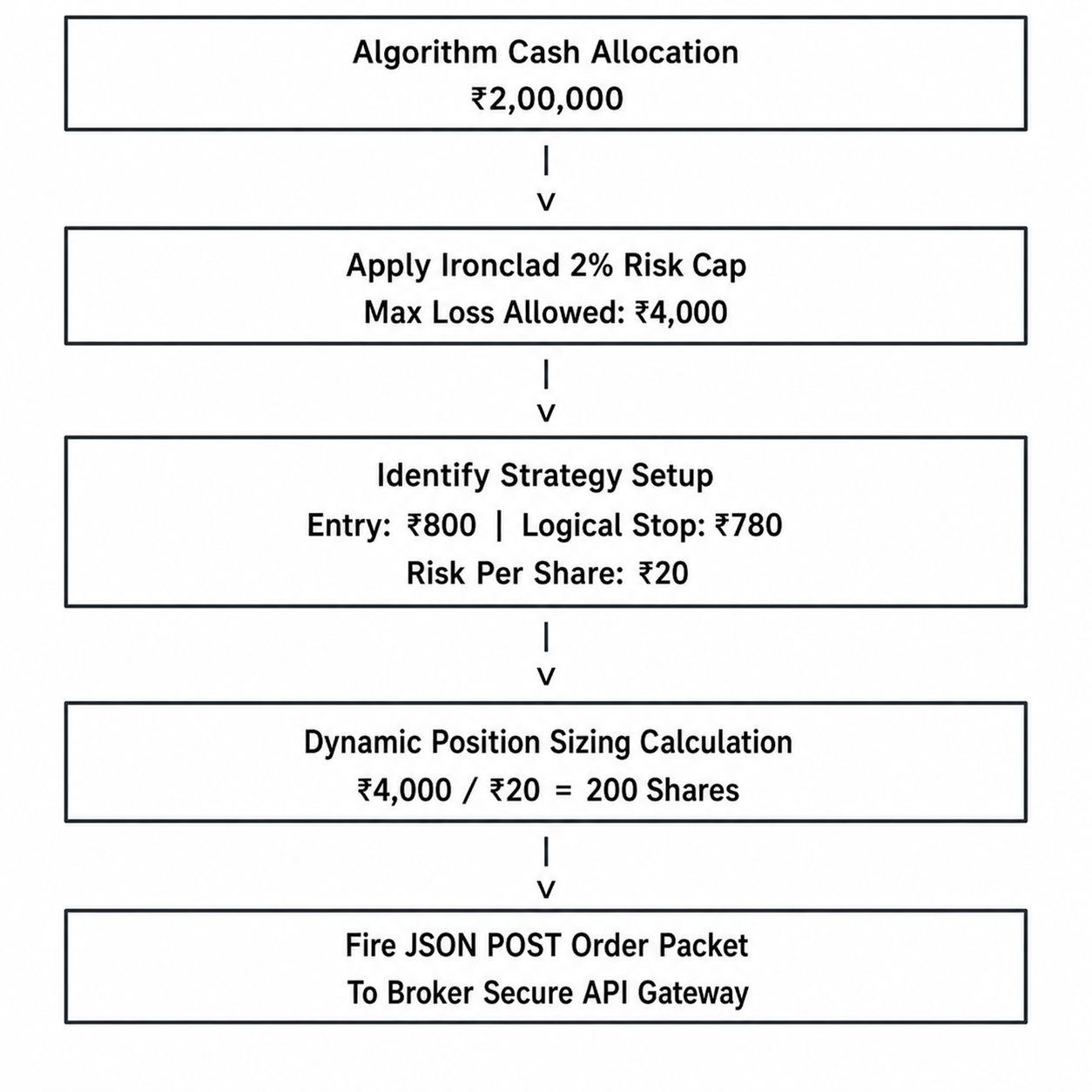
Let’s look at a concrete operational example. Imagine your algorithm carries a total cash allocation of ₹2,00,000. Under the strict 2% rule, your maximum permissible rupee loss on a single live setup is capped at exactly ₹4,000.
If your technical entry parameter triggers a buy order for State Bank of India (SBI) at ₹800, and the structural chart dictates that your logical stop-loss belongs at ₹780 (a distinct ₹20 risk per share), your script’s position sizing engine must run this internal calculation before routing the POST packet:
Position Size = Maximum Rupee Risk / Stop-Loss Distance = ₹4,000 / ₹20 = 200 Shares
The algorithm automatically calibrates the order to exactly 200 shares. If the trade fails and the price drops to ₹780, the system exits instantly, containing your drawdown to a manageable, non-catastrophic paper cut. To master how these risk constraints function across highly volatile market regimes to ensure your terminal survives unexpected Black Swan events, studying a complete protocol for managing risk in the Indian stock market is an absolute operational necessity.
The Systemic Circuit Breaker
Beyond localized trade risk, your master script logic must feature an aggregate portfolio circuit breaker. You must code a hard threshold into your control dashboard—for instance, a maximum daily drawdown limit of 3% of total capital.
If the market enters an exceptionally chaotic regime where consecutive stop-losses are triggered across multiple uncorrelated strategies, and your aggregate portfolio balance drops by 3% in a single session, the master controller must execute an immediate kill-switch. It must systematically cancel all passive resting orders on the exchange book, close all open positions, revoke the API authentication tokens, and halt execution completely until the next trading day. This rule prevents a rogue script loop or unexpected data fee corruption from devastating your capital.
7. Overcoming the Friction: STT, Execution Slippage, and Tech Fails
When you run automated strategies inside a backtesting sandbox, the data looks immaculate. Your profit curves climb smoothly, your drawdowns look contained, and the math looks spectacular. Retail beginners frequently review these paper reports, experience a surge of pure greed, and instantly scale up their position sizes using maximum leverage.
Then they go live, and the strategy starts leaking capital.
They fail because they completely ignore the invisible, real-world friction of live execution. The financial market is an imperfect, zero-sum environment. To achieve long-term profitability, your algorithms must be explicitly engineered to survive the dual forces of statutory transaction taxes and technology failures.
The Silent Account Killer: Transaction Cost Stacks
Every single time your algorithm fires a POST command and fills an order on the exchange matching book, the system extracts a toll. In India, this transactional stack is highly dense:
| Brokerage Fees: Flat fees per executed order (typically ₹20 with discount brokers). Securities Transaction Tax (STT): A mandatory government levy charging 0.1% on delivery transactions and 0.025% on intraday equity transactions. Exchange Transaction Charges: Fees pocketed directly by the NSE or BSE to maintain matching logs (roughly 0.00325%). SEBI Turnover Fees: Regulatory tracking fees. Goods and Services Tax (GST): A flat 18% tax applied directly to your broker’s fees and exchange transaction charges. Stamp Duty: Levied at 0.003% on buy orders. |
When you add this full stack together, a round-trip intraday trade carries a persistent operational drag of roughly 0.1% to 0.2% of your total transaction value. If you design a high-velocity automated scalping strategy that aims to capture tiny price moves of 0.3% per trade, transaction costs alone will consume up to 60% of your gross gains. Any algorithmic strategy that does not feature an expectation score calculated after factoring in this full tax stack is mathematically guaranteed to slowly bleed your account capital to zero.
The Reality of Execution Slippage
Slippage is the difference between the price your algorithm calculated an entry at on your chart and the actual filled price recorded on the exchange ledger. In a live auction environment, price does not move continuously; it gaps.
Imagine your code tracks an active breakout strategy. The script states that if a stock climbs past ₹1,000, it must instantly buy. The stock hits ₹1,000.05. Your script generates the JSON order packet and fires it across the web.
But during the few milliseconds it takes for those data packets to travel across the internet network, a massive institutional fund fires a multi-million rupee market buy order, completely clearing out all available sell orders up to ₹1,001.50.
Your order executes at ₹1,001.50. You paid an extra ₹1.45 per share purely due to network latency and matching order depth. This is execution slippage. If your strategy does not possess a wide enough profit margin to absorb regular slippages, its live performance will look drastically worse than its backtested reports.
Shifting From Ad-Hoc Tools to Immersive Mentorship
The barrier to entry for automated trading has been entirely dismantled. The fact that any independent retail investor can open a secure API gateway on their smartphone and execute algorithmic models from a coffee shop is a true technological miracle. However, this ease of accessibility creates a profound behavioral illusion.
Many beginners assume that because they have access to elite software tools, they possess market competency. They spend thousands of rupees on premium platform subscriptions, patch together random public indicators they do not understand, and wonder why their accounts bleed capital during live market hours.
The market is an incredibly efficient machine designed to systematically extract wealth from the unstructured speculator and hand it directly to the highly disciplined practitioner. To build a compounding automated system that endures across multiple economic regimes, you cannot rely on automated tools alone to save you. You must invest heavily in building your own core cognitive framework.
Theoretical literacy through online video channels can introduce basic programming languages and API terminology. But bridging the wide gap between conceptual literacy and execution confidence under pressure requires structured, hands-on mentorship. This is exactly why immersive, physical training environments exist.
For aspiring systematic traders operating across the Delhi-National Capital Region (NCR) who wish to escape the trial-and-error cycle of solo trading, partnering with a mentor desk can compress the learning curve dramatically. Immersive hubs like the Trading Smart Edge (TSE) Institute in Pitampura, Delhi run dedicated programs designed to transform independent investors into systematic operators.
Rather than leaving students to navigate dangerous execution and risk traps through expensive real-money drawdowns, a professional training curriculum pairs beginners with active market practitioners inside live-market training rooms. Students learn to accurately translate strategic ideas into robust automated logic blocks, backtest indicators across real historical exchange data feeds, and analyze performance logs with expert oversight.
Learning how to properly filter through the noisy educational market is a vital skill. If you want a clear checklist to evaluate coaching quality across the region, reading our comprehensive strategic guide on choosing a reliable trading academy in Delhi NCR breaks down the exact regulatory milestones, credentials, and curriculum criteria to look for before enrolling your time and resources.
Building Your Multi-Week Automation Launchpad
Transitioning into automated trading requires a highly structured developmental runway. Do not fund a live API terminal today and start running unverified scripts tomorrow morning. You must advance methodically through distinct validation gates.
The Foundation and Backtesting Phase
Spend your initial weeks focusing exclusively on logic and data integrity without linking a live wallet. Master the core mechanics of market architecture, analyze corporate balance sheets, and formalize your strategy rules.
Once your strategy parameters are fixed, upload your logic blocks into a backtesting engine using high-density historical data. Meticulously track your performance metrics across multiple market regimes—analyze how your strategy performs during a trending bull market, a bleeding bear market, and a stagnant, sideways consolidation phase. If you need a comprehensive manual on how to structure this baseline chart analysis cleanly without indicator clutter, studying a foundational text like a beginner’s guide to technical analysis in India provides a massive operational advantage.
The Live Sandbox Gate (Forward Testing)
Once your strategy proves it carries a mathematically positive expectancy score across historical data, deploy it to a live sandbox paper trading engine. This phase is non-negotiable.
Forward testing allows you to witness how your algorithm handles real-time live data feeds during the volatile opening minutes of the NSE session. Meticulously log your execution metrics: check your filled prices against your trigger boundaries, audit how your automated trailing stop-losses behave under live momentum, and track your script’s latency logs. For individuals seeking a highly structured, week-by-week layout to navigate this transition safely without devastating real-money failures, working through a structured 8-week stock trading plan offers an exceptional developmental launchpad to lock these habits into your daily routine.
Active automated trading requires a completely sober relationship with data data vectors. Checking how elite systematic professionals construct their daily execution funnels by analyzing our comprehensive masterclass on building consistent intraday trading profits provides the ultimate operational standard to benchmark your automated systems against.
Your Pre-Launch Automation Summary Checklist
Before you authenticate your broker API connection tokens tomorrow morning, pass your automated terminal through this final operational verification checklist:
| Link an Uncompromised Security Layer: Ensure your master code terminal and broker portal utilize rigid two-factor authentication (2FA).Meticulously protect your private API secret keys and access tokens; never paste your raw authentication strings into unverified public code repositories. Verify the Automated e-DIS Mandate: If you intend to run automated strategies across long-term delivery equity holdings, ensure your ledger is fully integrated with an Electronic Delivery Instruction Slip (e-DIS) framework secured by a central CDSL TPIN. This setup allows your algorithm to digitally authorize share transfers securely during sell triggers without processing stalls. Audit the Real-Time Error Logs: Ensure your script logic contains robust try-catch exception handling. If your network gateway experiences a momentary dropout or a specific data packet arrives corrupted, the script must handle the error gracefully, log the event, and safely retry the connection without crashing the master program. Confirm Your Nominal Beneficiary: Ensure you explicitly assign a legal nominee to your primary demat vault. This protects your family from agonizing bureaucratic hurdles if your wealth assets ever need to be securely transferred to your heirs. |
The retail financial landscape in India is navigating an unprecedented structural golden age. The capital market transit speeds, cloud computing accessibility, and data streaming networks sitting at your fingertips today were completely unavailable to elite institutional fund desks twenty years ago. The machinery of automation has been entirely democratized. Choose the tools and platforms that perfectly align with your cognitive wiring, wrap your code blocks inside unyielding risk limits, and let the mathematics of systematic execution compound your wealth. Your launchpad is optimized; execute with absolute care.