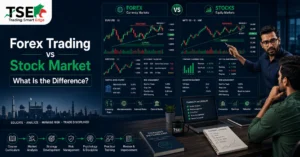
Forex and stock trading are two different ways of participating in financial markets. Forex trading involves trading currency pairs, while stock trading involves buying or selling shares or other equity-related instruments.
For beginners, the important question is not simply which market is “better.” The more useful comparison is how the two markets differ in terms of instruments, market drivers, trading hours, leverage, volatility, analysis, costs and risk.
This guide compares forex trading vs stock market and explains what beginners should understand before choosing a market to study.
Educational disclaimer: This article is for educational purposes only. It does not constitute investment advice or a recommendation to trade any financial instrument. Trading and leveraged derivatives can involve substantial risk.
Forex Trading vs Stock Market: Quick Comparison
| Factor | Forex Trading | Stock Market |
| What is traded? | Currency pairs | Shares/equity securities |
| Example | EUR/USD | Shares of a listed company |
| Main focus | Relative value between currencies | Ownership/value of companies |
| Major price drivers | Interest rates, inflation, economic data, central-bank policy | Earnings, valuation, sector conditions, economy |
| Trading hours | Global market sessions | Exchange-specific hours |
| Leverage | Depends on product/provider | Depends on product/provider |
| Fundamental analysis | Macroeconomic factors | Company and macroeconomic factors |
| Technical analysis | Commonly used | Commonly used |
| Risk | Can be significant | Can be significant |
| Best for | Those interested in currency markets | Those interested in companies/equities |
The exact trading conditions, costs and permitted products depend on the specific market, broker, exchange and jurisdiction.
What Is Forex Trading?
Forex, or foreign exchange, is the market where currencies are exchanged.
Unlike buying a single asset such as a company’s stock, forex is quoted as a currency pair.
For example:
EUR/USD = 1.1000
This represents the relative value of the euro against the US dollar.
A trader who expects EUR/USD to rise may take a long position, while someone expecting it to fall may take a short position.
To understand forex properly, beginners should learn:
- Currency pairs
- Base and quote currency
- Pips
- Spreads
- Leverage
- Margin
- Volatility
- Economic events
- Central-bank policy
- Risk management
What Is Stock Market Trading?
The stock market allows investors and traders to buy and sell securities representing ownership or economic exposure to companies.
For example, when an investor purchases shares of a listed company, they acquire an ownership interest represented by those shares.
Stock prices can be influenced by factors such as:
- Company earnings
- Revenue growth
- Profitability
- Valuation
- Management decisions
- Industry conditions
- Interest rates
- Economic growth
- Investor sentiment
- Corporate announcements
Stock-market participants may include long-term investors, swing traders, intraday traders and other market participants.
Forex vs Stocks: What Is Actually Being Traded?
This is the fundamental difference.
Forex
You trade the relative value of one currency against another.
Example:
EUR/USD
Stocks
You trade securities representing an interest in a company.
Example:
Shares of a listed Indian company
Therefore, forex is primarily a currency market, while stocks are primarily an equity market.
Forex vs Stock Market: How Do Prices Move?
The factors influencing each market are different.
Forex Price Drivers
Forex markets can respond strongly to:
- Interest-rate expectations
- Central-bank decisions
- Inflation
- Employment data
- GDP
- Trade data
- Political developments
- Geopolitical events
- Relative economic strength
For example, changes in expectations around US interest rates can influence the US dollar and therefore currency pairs involving USD.
Stock Price Drivers
Individual stocks can be influenced by:
- Revenue
- Earnings
- Profit margins
- Company guidance
- Corporate actions
- New products
- Management changes
- Industry developments
- Economic conditions
- Investor expectations
This means stock analysis often requires understanding the specific company, whereas forex analysis frequently involves understanding relative macroeconomic conditions between economies.
Forex Trading vs Stock Trading: Market Hours
Another major difference is market structure.
Forex Market
Forex trading operates across major global financial centres, with commonly discussed sessions including:
- Sydney
- Tokyo
- London
- New York
This creates a global trading cycle across different time zones.
Stock Market
Stock trading generally takes place during the operating hours of the specific exchange.
For Indian equities, market participants follow the trading schedule of the relevant Indian exchanges.
Therefore, stock traders usually work within defined exchange sessions, while global forex markets operate across multiple international sessions.
Is Forex More Volatile Than Stocks?
There is no universal answer.
Volatility depends on:
- Instrument
- Time period
- Market conditions
- Economic events
- Liquidity
- Trading session
A major currency pair may experience relatively controlled movements compared with an individual stock, while a major economic announcement can create substantial short-term currency volatility.
Similarly, an individual stock can experience very large price movements because of earnings, corporate announcements or unexpected news.
The correct approach is to assess the volatility of the specific instrument, rather than assuming one entire market is always more volatile.
Forex vs Stocks: Leverage
Leverage is an important distinction for beginners.
Leverage allows a trader to obtain greater market exposure relative to the capital or margin posted, depending on the financial product and provider.
Forex
Some forex products can provide leverage.
Stocks
Leverage may also be available through certain products, brokers or derivatives, but the terms differ.
The key point is:
Leverage magnifies both potential gains and potential losses.
Beginners should understand margin requirements and maximum potential loss before using leveraged products.
Forex Trading vs Stock Market: Fundamental Analysis
Fundamental analysis looks different in the two markets.
Forex Fundamental Analysis
Forex traders may study:
- Interest rates
- Inflation
- GDP
- Employment
- Central-bank policy
- Economic growth
- Trade balances
- Political and geopolitical developments
The focus is often on comparing the economic outlook of two currencies.
Stock Fundamental Analysis
Stock investors may examine:
- Revenue
- Earnings
- Profit margins
- Debt
- Cash flow
- Valuation
- Competitive position
- Management
- Industry growth
The analysis is therefore more company-specific.
Forex vs Stocks: Technical Analysis
Technical analysis is used in both markets.
Common tools include:
- Support and resistance
- Trendlines
- Market structure
- Moving averages
- RSI
- MACD
- Volume
- Candlestick analysis
- Price action
The principles are broadly similar, but the way they are applied can differ depending on the instrument and timeframe.
A beginner should learn market structure and risk management before accumulating a large collection of indicators.
Forex vs Stock Market: Costs
Trading costs differ depending on the specific product and provider.
Forex Costs May Include
- Spread
- Commission
- Financing or overnight charges
- Currency conversion costs
Stock Trading Costs May Include
- Brokerage
- Exchange-related charges
- Taxes and levies
- Bid-ask spread
- Other transaction costs
The exact cost structure should always be checked with the relevant broker or trading platform.
A strategy that looks profitable before costs may not remain profitable after transaction expenses.
Forex vs Stocks: Long-Term Investing vs Short-Term Trading
This is another important distinction.
Stocks are commonly associated with long-term investing, where investors may hold shares for years based on company fundamentals and growth expectations.
However, stocks can also be traded over shorter periods.
Forex is commonly associated with active trading, including:
- Intraday trading
- Swing trading
- Short-term trend following
However, currency exposure can also be managed over longer periods.
Therefore, neither market belongs exclusively to one timeframe.
Forex vs Stock Market for Beginners
A beginner should consider their learning objectives rather than simply asking which market is easier.
Forex May Suit Learners Interested In:
- Currency markets
- Macroeconomics
- Interest rates
- Central-bank policy
- Global economic relationships
- Currency-pair analysis
Stocks May Suit Learners Interested In:
- Companies
- Business models
- Earnings
- Valuation
- Industries
- Long-term investing
- Equity analysis
Neither choice eliminates risk.
Which Is Easier to Learn: Forex or Stocks?
Neither market is automatically easy.
Forex requires understanding:
- Currency relationships
- Macroeconomic data
- Monetary policy
- Leverage
- Margin
- Volatility
Stock trading requires understanding:
- Company fundamentals
- Valuation
- Market structure
- Sector trends
- Corporate announcements
- Technical analysis
The difficulty depends on the individual’s background, learning approach and trading objectives.
Forex Trading vs Stock Market: Risk
Both markets involve risk, but the sources of risk can differ.
Forex Risks
- Leverage
- Rapid price movements
- Economic announcements
- Interest-rate changes
- Currency volatility
- Counterparty/platform considerations depending on product
Stock Risks
- Company-specific events
- Earnings disappointments
- Market downturns
- Sector risk
- Liquidity risk
- Valuation risk
- Leverage where applicable
Risk management is therefore essential regardless of the market.
Common Mistakes Beginners Make in Both Markets
Trading Without a Plan
Entering positions without predefined criteria can lead to inconsistent decisions.
Using Excessive Leverage
Leverage can turn a relatively small market movement into a substantial gain or loss.
Ignoring Transaction Costs
Spreads, commissions and other costs affect actual results.
Overtrading
More trades do not necessarily mean better results.
Chasing Losses
Trying to recover losses quickly can increase risk.
Following Unverified Trading Calls
Beginners should learn how to analyse a market rather than depending entirely on someone else’s entry or exit.
Expecting Guaranteed Returns
No legitimate trading strategy can guarantee profits.
Which Market Should Beginners Learn First?
There is no universal answer.
Choose based on what you want to understand.
If your interest is primarily in companies, business performance and long-term equity investing, studying the stock market may be a logical starting point.
If your interest is in currencies, macroeconomics, interest rates and global economic relationships, forex may be more relevant.
Regardless of the market, learn these foundations:
Market Basics → Technical/Fundamental Analysis → Risk Management → Trading Plan → Practice → Review
Forex Trading Course in Delhi
If you want structured education in forex rather than learning individual concepts from disconnected sources, you can explore the Forex Trading Course in Delhi offered by Trading Smart Edge.
A useful forex curriculum should cover:
- Currency-pair fundamentals
- Forex market structure
- Technical analysis
- Price action
- Market structure
- Risk management
- Trading psychology
- Practical analysis
- Relevant regulatory considerations for Indian learners
If you are starting from the basics, the Forex Trading Course for Beginners can help you understand the type of foundation a beginner-oriented program should provide.
For a broader learning roadmap, read How to Learn Forex Trading in India.
If you are comparing training providers, you can also review Best Forex Trading Course in Delhi.
Frequently Asked Questions
Is forex trading better than stock trading?
Not universally. Forex and stocks are different markets with different instruments, drivers, risks and learning requirements. The better choice depends on your objectives and market interests.
Is forex riskier than stocks?
Neither market is inherently always riskier. Risk depends on the instrument, volatility, leverage, position size, timeframe and trading strategy.
Can beginners trade both forex and stocks?
They can study both, but learning one market properly before adding another can make the learning process more manageable.
Which is better for long-term investing: forex or stocks?
Stocks are commonly used for long-term investing because investors can own shares in businesses. Forex is more commonly associated with currency trading and macroeconomic exposure. The suitability depends on the specific objective and product.
Which requires more fundamental analysis?
Forex fundamental analysis focuses heavily on macroeconomic factors such as interest rates, inflation and central-bank policy. Stock fundamental analysis often requires detailed company and industry analysis.
Can technical analysis be used for both forex and stocks?
Yes. Technical analysis techniques such as support and resistance, trends, market structure and indicators can be applied to both markets.
Is leverage available in forex and stocks?
Leverage can be available in both markets through certain products and providers, but the rules, limits and risks differ. Traders should understand the exact product before using leverage.
Should beginners learn forex or stocks first?
Start with the market that aligns with your objectives and interests. Whichever market you choose, learn risk management before focusing heavily on strategies.
Final Takeaway
The main difference between forex trading vs stock market is what you are analysing.
Forex:
Currency → Currency relationship → Macroeconomics → Interest rates → Central banks
Stocks:
Company → Earnings → Valuation → Industry → Economic conditions
Both markets require discipline, risk management and a structured approach.
There is no market where knowledge eliminates risk, and there is no legitimate strategy that guarantees profits.
If forex is the market you want to study, explore the Forex Trading Course in Delhi and Forex Trading Course for Beginners.
You can also read How to Learn Forex Trading in India and compare your options through Best Forex Trading Course in Delhi.
If you want to evaluate the learning format before enrolling, Book a Free Demo Class.
Educational Disclaimer
This article is provided for educational and informational purposes only. It does not constitute investment advice, financial advice, research advice or a recommendation to buy or sell any security, currency or derivative. Trading and leveraged financial products can involve substantial risk and may result in significant losses. Indian residents should verify current regulations, permitted products and applicable requirements with relevant authorised Indian authorities before trading. No trading strategy, course or educational program can guarantee profits.