
Quick Answer: Direct Mutual Funds are generally better for investors who can manage their own investments because they have lower expense ratios and no distributor commission. Regular Mutual Funds include commissions paid to intermediaries, making them more expensive over the long term. The investment portfolio remains the same in both plans; only the cost differs.
Key Takeaways
- Direct plans have lower expense ratios that boost your long-term compounding.
- Regular plans include hidden distributor commissions that reduce your net returns.
- The underlying portfolio (stocks held, fund manager, and market risk) remains identical in both plans.
- Long-term wealth grows significantly faster in direct plans due to lower cost drag.
- Fee-only advisors offer a superior alternative to commission-based distributors for those needing professional guidance.
Introduction
Imagine investing ₹25,000 every month for 20 years. You choose a good mutual fund, stay disciplined, and earn healthy market returns. But when you compare your portfolio with someone who invested in the exact same fund, you discover they have ₹20 to ₹30 lakh more than you. The difference isn’t luck—it comes down to choosing a Direct Plan instead of a Regular Plan.
Many investors get confused by the multitude of fund variants available on investment platforms. Understanding the structural differences between these plans is vital because minor fee variations compound into massive financial gaps over decades. This guide explores everything you need to know about regular versus direct mutual funds, detailing cost impacts, calculator projections, switching mechanisms, and tax implications.
What is a Mutual Fund?
A mutual fund is a professionally managed investment vehicle that pools money from multiple investors to purchase a diversified basket of securities.
- Mutual Fund: A collective investment scheme managed by an Asset Management Company (AMC).
- NAV (Net Asset Value): The per-unit price of a mutual fund scheme, calculated daily based on portfolio performance.
- AMC (Asset Management Company): The financial institution (such as SBI Mutual Fund, HDFC Mutual Fund, or Nippon India) that manages the fund pool.
- Expense Ratio: The annual fee charged by the AMC to manage the fund and cover operational costs.
What is a Regular Mutual Fund?
Regular mutual funds are purchased through intermediaries, such as banks, distributors, relationship managers, or offline financial agents.
- The Distributor Model: When you buy a regular plan, the AMC pays a recurring commission (known as trail commission) to the intermediary out of your fund’s assets.
- Process Flow:
- Investor → Distributor / Bank → AMC → Fund Portfolio
What is a Direct Mutual Fund?
Direct mutual funds are purchased directly from the Asset Management Company or through SEBI-registered online discount brokerage and investment platforms without any intermediary involvement.
- No Intermediary: Because there is no distributor or agent involved, the AMC incurs zero distribution expenses, resulting in a lower expense ratio.
- Process Flow:
- Investor → AMC (Direct Platform) → Fund Portfolio
Regular vs Direct Mutual Funds (Comparison Table)
| Feature | Direct Plan | Regular Plan |
| Expense Ratio | Lower | Higher |
| Commission | None | Yes (Paid to distributor) |
| Returns | Higher | Lower |
| Fund Manager | Same | Same |
| Portfolio | Same | Same |
| Risk | Same | Same |
| NAV | Higher | Lower |
| Best For | DIY Investors | Investors needing ongoing guidance |
Why Direct Mutual Funds Generate Higher Returns

The mathematical advantage of direct plans stems from cost drag reduction. Because fewer fees are deducted daily from your fund assets, your net asset value grows at an accelerated rate, creating a compounding snowball effect over multi-year horizons.
How Much Money Can You Save? (Calculator Example)
The following table demonstrates the wealth gap created by expense ratio differences over a 20-year horizon:
| Monthly SIP | Investment Period | Regular Plan Value | Direct Plan Value | Extra Wealth Generated |
| ₹5,000 | 20 Years | ₹46 Lakh | ₹51 Lakh | ₹5 Lakh |
| ₹10,000 | 20 Years | ₹92 Lakh | ₹1.02 Crore | ₹10 Lakh |
| ₹25,000 | 20 Years | ₹2.30 Crore | ₹2.56 Crore | ₹26 Lakh |
Expense Ratio Explained
The expense ratio represents the annual percentage of your total investment deducted by the AMC to manage the scheme.
- TER (Total Expense Ratio): Covers management fees, administrative costs, custodian fees, and marketing expenses.
- Commission Component: In regular plans, the TER includes distributor commissions (often 0.5% to 1.0% annually). Direct plans strip out this commission entirely, lowering the total expense ratio.
Does Direct Mutual Fund Have More Risk?
No. Direct and regular mutual funds carry identical market risks. Because both plans invest in the exact same underlying stocks or bonds managed by the same fund manager, market volatility and downside risks are completely identical. Returns differ solely due to the cost efficiency of direct plans.
Are Direct and Regular Mutual Funds Managed Differently?
No. They are managed identically in every operational aspect:
- Same Fund Manager: Oversees both pools simultaneously.
- Same Stocks: Holds the identical portfolio of securities and asset allocation.
- Same Risk Profile: Subject to the exact same market movements and economic conditions.
- Same Strategy: Follows the identical investment mandate and benchmark index.
Who Should Choose Direct Mutual Funds?
| Investor Profile | Suitability |
| Salaried Employees | Ideal for disciplined monthly wealth builders. |
| DIY Investors | Perfect for individuals who manage their own portfolios. |
| Long-Term Investors | Maximizes compounding over multi-decade horizons. |
| SIP Investors | Ideal for automated, systematic monthly investors. |
| Experienced Investors | Well-suited for those comfortable using digital platforms. |
Who Should Choose Regular Mutual Funds?
Regular plans can still make sense for investors who genuinely need ongoing, hands-on guidance from a dedicated advisor and are comfortable paying for that advisory service. However, many modern investors prefer separating advice from execution by hiring fee-only financial planners while executing their portfolios directly through commission-free direct plans.
Direct vs Regular Mutual Fund Taxation
Tax liabilities for mutual funds are determined by asset class and holding period, not by whether the plan is direct or regular:
| Tax Parameter | Direct Plan | Regular Plan |
| STCG (Short-Term Capital Gains) | Taxed according to applicable slab / asset rules | Same as direct plans |
| LTCG (Long-Term Capital Gains) | Taxed according to current statutory rates | Same as direct plans |
| Exit Load | Applicable if redeemed within specified windows | Same as direct plans |
How to Switch from Regular to Direct Mutual Funds
Switching from a regular plan to a direct plan requires a systematic approach to minimize tax and exit load impacts:
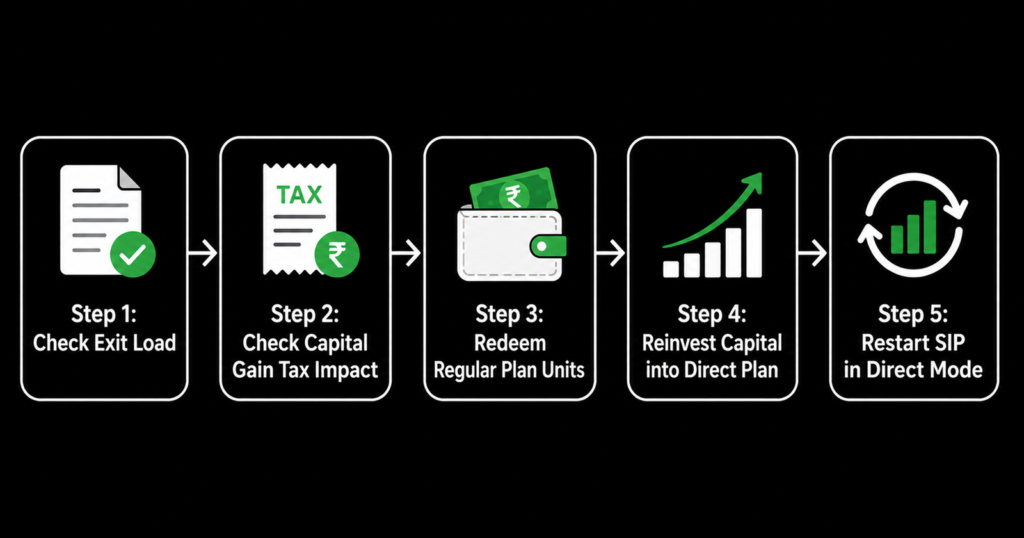
Common Mistakes Investors Make
- Blindly accepting bank relationship manager recommendations without checking expense ratios.
- Ignoring the compounding impact of higher expense ratios over long timeframes.
- Chasing short-term category returns rather than focusing on cost efficiency.
- Switching funds too frequently, triggering unnecessary exit loads and tax events.
- Stopping systematic investment plans (SIPs) during market corrections.
- Failing to evaluate the tax implications of redeeming regular units before switching.
Myths About Direct Mutual Funds
| Myth | Reality |
| Direct Funds are Riskier | False. Both plans hold the identical underlying stock portfolio. |
| Returns Differ Due to Different Portfolios | False. Portfolio composition is 100% identical; differences stem entirely from fees. |
| Regular Funds are Safer | False. Safety depends on asset allocation, not the intermediary channel. |
| Direct Funds Need Advanced Financial Knowledge | False. Modern online platforms make direct investing simple and automated. |
Real-Life Example
Consider Rahul, age 28, who starts a monthly SIP of ₹15,000 for a 20-year horizon:
- In a Regular Plan: Due to higher expense ratios and distributor commissions, his corpus compounds at a slightly lower net rate.
- In a Direct Plan: Saving approximately 0.75% to 1% annually in expenses allows his capital to compound more efficiently.
- The Outcome: Over 20 years, Rahul saves roughly ₹15 lakh in unnecessary fee drag, translating into a substantially larger retirement corpus in the direct plan.
Expert Tips Before Choosing
- Always compare expense ratios across competing fund houses before investing.
- Verify that your net returns are evaluated after accounting for all expense deductions.
- Select the Growth option rather than the dividend option to maximize compounding.
- Stay invested consistently through market cycles without panicking during dips.
- Avoid frequent fund switching that triggers exit loads and tax liabilities.
- Review your portfolio allocation at least once a year.
Frequently Asked Questions
1. Which is better: Direct or Regular Mutual Fund?
Ans: Direct mutual funds are generally better because they feature lower expense ratios and no distributor commissions, resulting in higher long-term returns.
2. Can I switch from Regular to Direct?
Ans: Yes, you can redeem your regular plan units and reinvest the proceeds into a direct plan, keeping tax and exit load rules in mind.
3. Is there any tax while switching?
Ans: Yes, redeeming units from a regular plan triggers capital gains tax and potential exit loads if done within the lock-in or exit window.
4. Is the fund manager different?
Ans: No, the exact same fund manager manages both the direct and regular plans of a specific scheme.
5. Does NAV differ?
Ans: Yes, direct plans have a higher NAV than regular plans because fewer expenses are deducted from the fund’s assets over time.
6. Are returns guaranteed?
Ans: No, mutual fund returns depend on market performance and are not guaranteed.
7. Should beginners invest in Direct Plans?
Ans: Yes, beginners can easily invest in direct plans using user-friendly online investment platforms without needing a distributor.
8. Can I invest directly through AMC?
Ans: Yes, you can invest directly through the official website or portal of the Asset Management Company.
9. Is Groww a Direct Mutual Fund platform?
Ans: Yes, investment platforms like Groww offer direct mutual fund plans without charging commissions.
10. Is Zerodha Coin a Direct Mutual Fund platform?
Ans: Yes, Zerodha Coin provides commission-free direct mutual fund investments.
11. What is the expense ratio?
Ans: The expense ratio is the annual fee charged by AMCs to manage a mutual fund scheme.
12. How much money can I save?
Ans: Switching to direct plans can save lakhs of rupees over long investment horizons due to lower fee drag.
13. Is SIP different in Direct Plans?
Ans: The mechanics of a Systematic Investment Plan (SIP) are identical; only the unit allocation cost is lower in direct plans.
14. Can I convert without selling?
Ans: Most platforms require you to redeem regular units and purchase direct units, though some platforms offer switch features that handle this seamlessly.
15. Are Direct Plans safe?
Ans: Yes, direct plans are regulated by SEBI and offer the exact same regulatory safety as regular plans.
Final Verdict
Choosing between direct and regular mutual funds is one of the most impactful decisions an investor can make. While regular plans route your hard-earned money toward intermediary commissions, direct plans keep your costs low and maximize the power of compounding. For investors seeking long-term financial independence, disciplined execution through direct plans offers a clear mathematical advantage. Take control of your financial future today by auditing your current holdings and transitioning to commission-free investing.
Related Articles (Internal Linking)
- Master fundamental principles with our Share Market Basics Investing Guide.
- Compare cash and delivery execution styles in Delivery Trading vs Intraday Trading.
- Explore technical momentum setups in Intraday Trading Setups.
- Learn disciplined execution strategies with Consistent Intraday Trading Profits in India.
- Choose the right operational tools using Best Stock Broker India Unbiased Comparison and Best Trading App in India.
- Accelerate your practical education with professional mentorship at our Trading Academy in Delhi NCR.