Quick Answer: No investor can consistently time the stock market over the long term. Historical data proves that missing just a few of the market’s best-performing days severely damages long-term returns. Rather than attempting speculative market timing, the superior alternative is disciplined, consistent investing through systematic frameworks like SIPs (Systematic Investment Plans) and proper asset allocation.
Key Takeaways
- Most retail and professional investors fail to time the market consistently.
- Missing a handful of the market’s strongest recovery days can reduce overall portfolio compounding significantly.
- Investing regularly outperforms emotional attempts to buy absolute bottoms and sell absolute tops.
- Risk management, diversification, and time in the market matter far more than trying to predict short-term price movements.
1. What Does Timing the Stock Market Mean?
Market timing is the practice of attempting to predict future price movements of equities or broader indexes to buy low and sell high. Instead of investing money regularly regardless of conditions, a market timer tries to move cash in and out of stocks based on macroeconomic forecasts, technical indicators, or political events.
- The Goal: To dodge market corrections entirely while capturing every upward swing.
- The Reality: It requires two correct decisions every single time—when to exit and when to re-enter. Getting either decision wrong destroys performance.
- Investing vs. Timing: Investing focuses on long-term business compounding and asset ownership, while market timing relies on short-term price speculation.
Related Resource: Build your foundational knowledge in What Is the Stock Market?.
2. Can Anyone Consistently Time the Stock Market?
No individual, institutional fund manager, or algorithmic model can consistently time the stock market across multiple decades.
- Human Psychology: Fear and greed cause investors to buy near market peaks and panic-sell near market troughs.
- Market Unpredictability: Stock prices reflect millions of competing global variables, corporate earnings reports, geopolitical shocks, and liquidity shifts that cannot be foreseen reliably.
- Expert Consensus: Legendary investors like Warren Buffett and academic studies consistently confirm that time in the market beats timing the market every time.
3. Why Investors Try to Time the Market
- Fear of Buying at the Top: Anxiety over deploying capital right before a market pullback.
- Waiting for Market Crashes: Holding cash on the sidelines hoping for a 30% discount that may take years to occur.
- Greed During Bull Markets: Chasing rapid upward momentum without checking valuations.
- News-Driven Investing: Reacting impulsively to sensationalized media headlines and economic forecasts.
- Social Media Influence: Listening to unverified stock tips or viral financial advice online.
4. What Historical Market Data Shows
Historical data across global equity markets (including NSE and BSE trends) demonstrates that markets trend upward over long horizons despite periodic corrections.
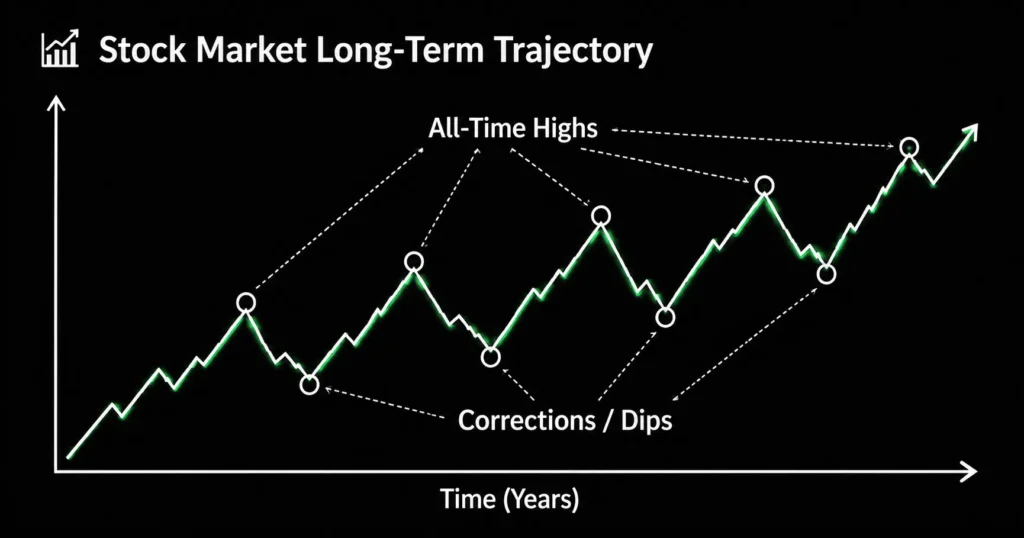
- Recovery After Corrections: Every major historical crash—including the 2008 financial crisis and the 2020 pandemic dip—was eventually followed by new all-time highs.
- Highs vs. Future Returns: Studies show that investing at historical market highs still yields positive annualized returns over 5 to 10-year holding periods.
5. The Biggest Mistakes Investors Make
- Waiting Forever for a Correction: Missing years of compounding returns and dividend growth while sitting in low-yield cash.
- Selling During Panic: Liquidating portfolios at the bottom of a market drop, locking in permanent losses.
- Buying After Rallies: Jumping into the market only after it has already surged, driven by FOMO.
- Emotional Investing: Letting temporary market volatility dictate long-term financial plans.
- Following Market Noise: Constantly checking daily portfolio fluctuations.
Related Resource: Learn to avoid common pitfalls in What Are the Biggest Mistakes Traders Make.
6. Why Market Timing Usually Fails
Emotional Decision Making
When markets crash, fear takes over, making it psychologically difficult to buy stocks while prices are falling. Conversely, euphoria at market peaks makes investors overconfident.
News-Based Investing
By the time financial news outlets report a major economic trend or sector boom, professional institutional players have already priced that information into the market.
Economic Predictions
Even top economists frequently misjudge interest rate cycles, inflation spikes, and recession timings. Relying on predictions to invest capital is highly speculative.
Unexpected Global Events
Black swan events—such as sudden geopolitical conflicts, pandemics, or supply chain shocks—cannot be predicted by technical charts or economic models.
Trying to Predict Market Bottoms
Trying to catch a falling knife often leads investors to buy too early, suffering deeper unrealized losses before any real recovery begins.
7. The Hidden Cost of Waiting
Sitting on cash waiting for the “right time” carries a heavy financial penalty:
- Opportunity Cost: Capital earns minimal interest while equity markets compound upwards.
- Inflation Impact: Cash purchasing power erodes steadily year after year due to inflation.
- Delayed Compounding: Starting your investment journey 5 years later drastically reduces your final wealth accumulation due to lost compounding time.
Related Resource: Understand macroeconomic impacts via How Inflation Affects Stock Market.
8. Missing the Best Trading Days
The greatest risk of market timing is missing the market’s best recovery days. Stock market gains tend to be concentrated in sudden, sharp upward bursts that frequently occur right after severe downturns.
| Investment Strategy | Final Portfolio Value (Hypothetical ₹10 Lakhs over 20 Years) |
| Fully Invested (Stayed the Course) | ₹65,00,000+ |
| Missed the 10 Best Days | ₹31,00,000 |
| Missed the 30 Best Days | ₹12,50,000 |
Missing just a handful of high-return days can cut your long-term wealth accumulation in half.
9. Investing Regularly vs. Timing the Market
| Factor | Regular Investing (SIP / Discipline) | Market Timing (Speculation) |
| Stress Level | Low (Automated, hands-off) | Extremely High (Constant chart watching) |
| Required Discipline | High initial setup; passive maintenance | Relentless active decision-making |
| Long-Term Returns | Historically reliable and stable | Highly volatile; often underperforms |
| Emotional Control | Removes emotion via automation | Highly vulnerable to panic and greed |
| Simplicity | Extremely simple and accessible | Complex and time-consuming |
| Risk Profile | Mitigated through rupee-cost averaging | Amplified by bad entry/exit timing |
10. SIP vs. Waiting for the Perfect Time
Systematic Investment Plans (SIPs) solve the market timing dilemma through Rupee Cost Averaging:
- When Markets Are High: Your fixed monthly investment buys fewer units.
- When Markets Correct: Your fixed monthly investment automatically buys more units at discounted prices.
- Long-Term Benefits: You eliminate the stress of finding the “perfect entry point” while building a disciplined, compounding habit.
Related Resource: Compare deployment methods in SIP vs Lump Sum Investing.
11. Should You Invest During Market Highs?
It is entirely normal to feel hesitant when investing at all-time market highs. However, historically, stock markets spend a significant portion of their long-term upward journey breaking into new highs.
- Business Ownership Mindset: When you buy equity, you are buying a fractional stake in cash-flowing, growing businesses—not just a flashing ticker symbol.
- Long-Term Horizon: Over 10 to 15 years, whether you bought at a minor peak or a local valley matters very little compared to the overall multi-year compounding trajectory.
12. What Should Beginners Do Instead?
Follow this simple, step-by-step framework to build a robust financial foundation:
- Build an Emergency Fund: Keep 6 months of living expenses in liquid debt instruments.
- Set Clear Financial Goals: Define your time horizons for retirement, home buying, or wealth creation.
- Invest Regularly: Set up automated monthly SIPs into diversified funds or blue-chip stocks.
- Diversify Investments: Spread capital across large-cap stocks, index funds, and asset classes like gold.
- Review Periodically: Rebalance your portfolio annually rather than weekly.
- Avoid Emotional Decisions: Ignore daily market noise and stick to your written investment policy.
Related Resource: Read our complete roadmap in Long-Term Investing Guide.
13. Common Myths About Market Timing
- Myth 1: “I should wait for the next big crash before investing.”
- Fact: Crashes are unpredictable, and staying out of the market usually costs you more in missed gains than the dip saves you.
- Myth 2: “Experts always know where the market is going.”
- Fact: Professional fund managers routinely fail to beat broad market index funds consistently over 10-year periods.
- Myth 3: “Buying at all-time highs is always risky.”
- Fact: Markets hit record highs frequently on their way to much higher valuations over decades.
- Myth 4: “Cash is always safer.”
- Fact: Holding excessive cash guarantees that inflation will erode your purchasing power over time.
- Myth 5: “I can predict the next market correction using technical indicators.”
- Fact: Technical analysis helps manage risk and entries, but no indicator can reliably forecast macro market tops or bottoms.
Related Resource: Learn technical fundamentals via Technical Analysis Basics.
14. When Does Market Timing Make Sense?
While trying to time entry and exit points for speculation is counterproductive, certain structural actions resemble timing but are actually sound risk management:
- Portfolio Rebalancing: Trimming outperforming asset classes once a year to maintain your target asset allocation.
- Risk Management: Reducing equity exposure as you approach a major near-term financial goal (e.g., buying a house next year).
- Tax Planning: Harvesting capital losses or gains strategically before fiscal year-ends.
15. Practical Checklist Before Investing
- [ ] Do I have a dedicated emergency fund secured?
- [ ] Am I investing with a minimum 5-to-10-year time horizon?
- [ ] Can I tolerate short-term market volatility without panicking?
- [ ] Is my portfolio properly diversified across sectors?
- [ ] Do I have a clear, documented investment plan?
16. Frequently Asked Questions (FAQ)
1. Can I really time the stock market?
Ans: No. Decades of market data prove that consistent market timing is virtually impossible for both retail and professional investors.
2. Is buying at market highs a bad idea?
Ans: Not necessarily. Markets hit all-time highs frequently during secular bull runs. Long-term compounding matters far more than short-term entry price perfection.
3. Should I wait for a correction to invest?
Ans: Waiting for a correction often results in missed returns and higher prices later, as markets can continue climbing much longer than expected.
4. Is SIP better than lump sum investing?
Ans: For most retail investors, SIPs (Systematic Investment Plans) are better because they remove emotional decision-making and utilize rupee cost averaging.
5. Why do investors fail to time the market?
Ans: Investors fail due to emotional bias, unpredictable macroeconomic shocks, and the impossibility of accurately predicting both market tops and bottoms.
6. How often does the stock market correct?
Ans: Minor corrections (5% to 10%) happen almost every year, while major bear markets (20%+) occur less frequently, usually every few years.
7. Can beginners time the market?
Ans: No. Beginners should focus on passive, disciplined long-term investing rather than speculative timing.
8. What is Rupee Cost Averaging?
Ans: It is an investment strategy where you invest a fixed amount regularly, buying more shares when prices are low and fewer when prices are high.
9. Should I stop investing during a market crash?
Ans: No, market crashes represent discounted buying opportunities for long-term investors maintaining a disciplined SIP approach.
10. Is long-term investing safer than short-term trading?
Ans: Yes. Long-term investing smooths out short-term market volatility and relies on business growth rather than price speculation.
17. Related Educational Resources
18. Final Verdict
Attempting to time the stock market is a tempting trap fueled by human emotion and the desire for quick gains. However, history repeatedly shows that discipline beats prediction.
Instead of wasting energy trying to outguess market tops and bottoms, focus on what you can control: consistent investing, robust asset allocation, risk management, and letting time compound your capital. Build long-term investing habits today, and let the power of the market work in your favor.